Big Apple Sky Calendar: July, August, September 2026
In the 1990s, astronomy professor Joe Patterson wrote and illustrated a seasonal newsletter, in the style of an old-fashioned paper zine, of astronomical highlights visible from New York City. His affable style mixed wit and history with astronomy for a completely charming, largely undiscovered cult classic: Big Apple Astronomy. For Broadcast, Joe shares current issues of Big Apple Sky Calendar, the guide to sky viewing that used to conclude his seasonal newsletter. Steal a few moments of reprieve from the city’s mayhem to take in these sights. As Oscar Wilde said, “we are all in the gutter, but some of us are looking at the stars.”
—Janna Levin, Broadcast co-editor-in-chief
July
July 1
Sunrise 5:27 am EDT
Sunset 8:33 pm EDT
July 6
Earth at aphelion. Today, the Earth is 1.017 AU (95 million miles) from the Sun—as distant as it ever gets. Yet it's the hottest time of year for us borealites. The reason is that the Sun's local heating of the Earth depends not on distance, but on the angle of the noontime sun (now nearly overhead for us) and on the length of sunlight (now 15 hours).
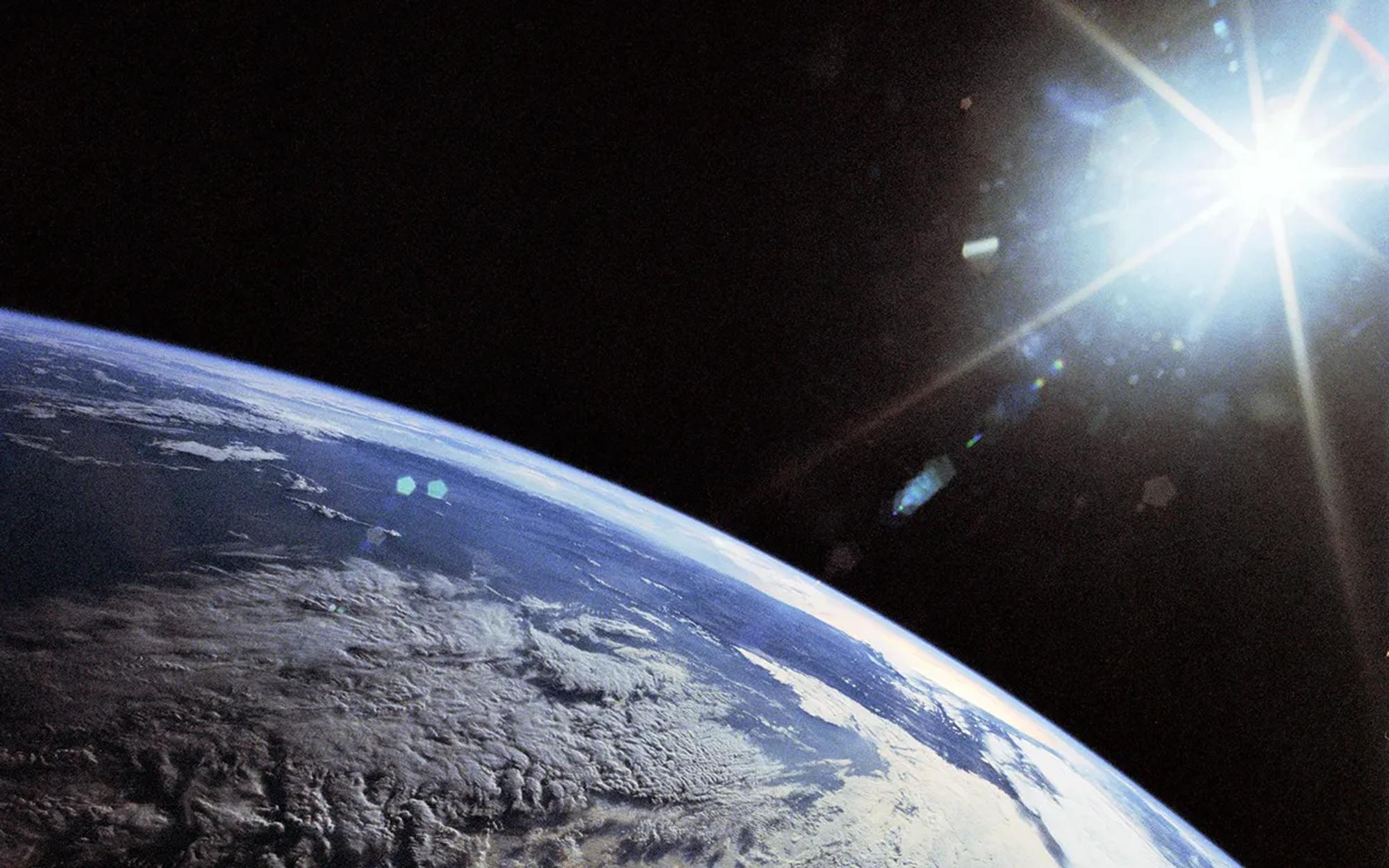
Planet Earth and the Sun viewed from space shuttle Discovery, April 1990.
Credit: NASAJuly 4
1054—The traditional date for the appearance of the most famous supernova in history. What we know for sure is that in the early summer of the year 1054, a very bright “guest star” (the Chinese word) appeared suddenly and was closely observed by Chinese, Japanese, and Korean astronomers. It was described as “visible in daylight” for 23 days and in the night sky for over a year. It must have been amazing to stargazers everywhere—but strangely enough, no definite record exists for its visibility in Europe or the Americas.
Today there is a little elliptical nebula in the sky, the Crab Nebula, which is the remnant of the 1054 explosion. Virginia Trimble, an American astronomer famous for her quick wit and insightful astrophysics, found that the nebula is rapidly expanding, such that it must have originated from a single point around the year 1100. This proved that the Crab Nebula originated in an explosion from a tiny, faint star at the center of the Nebula, or perhaps the ancestor of that star. A few years later, it was found that this star is a pulsar—a solid star, made entirely of neutrons and spinning at a rate of 30 times a second.
This star is 6500 light-years away—and if you do the math, you find that in the summer of 1054, this object was about as luminous (intrinsically) as an entire galaxy.
Holy mackerel! This was basically the beginning of modern stellar astrophysics. Two years later, the first black hole was discovered—and we were off and running.
But what's this “July 4” business? That's mainly a USA obsession. The ancient Chinese were exacting at dates, but not that exacting! (Or at least our knowledge of their dates is not that precise.) We do know three things that underlie the modern myth:
- On the morning of 5 July 1054, as viewed from the western USA, the waning crescent Moon was just northwest of the Crab Nebula's position.
- Several cave paintings/carvings from that region and era seem to show a round object (the supernova?) next to a crescent-shaped object of equal size (the Moon?).
- The Pueblo Indians of that era commonly made early-morning observations of the sky, perhaps to mark the seasons.
Despite this ultra-thin reed of evidence, few USA astronomy teachers can resist the re-telling of the patriotic supernova story. I certainly can't.
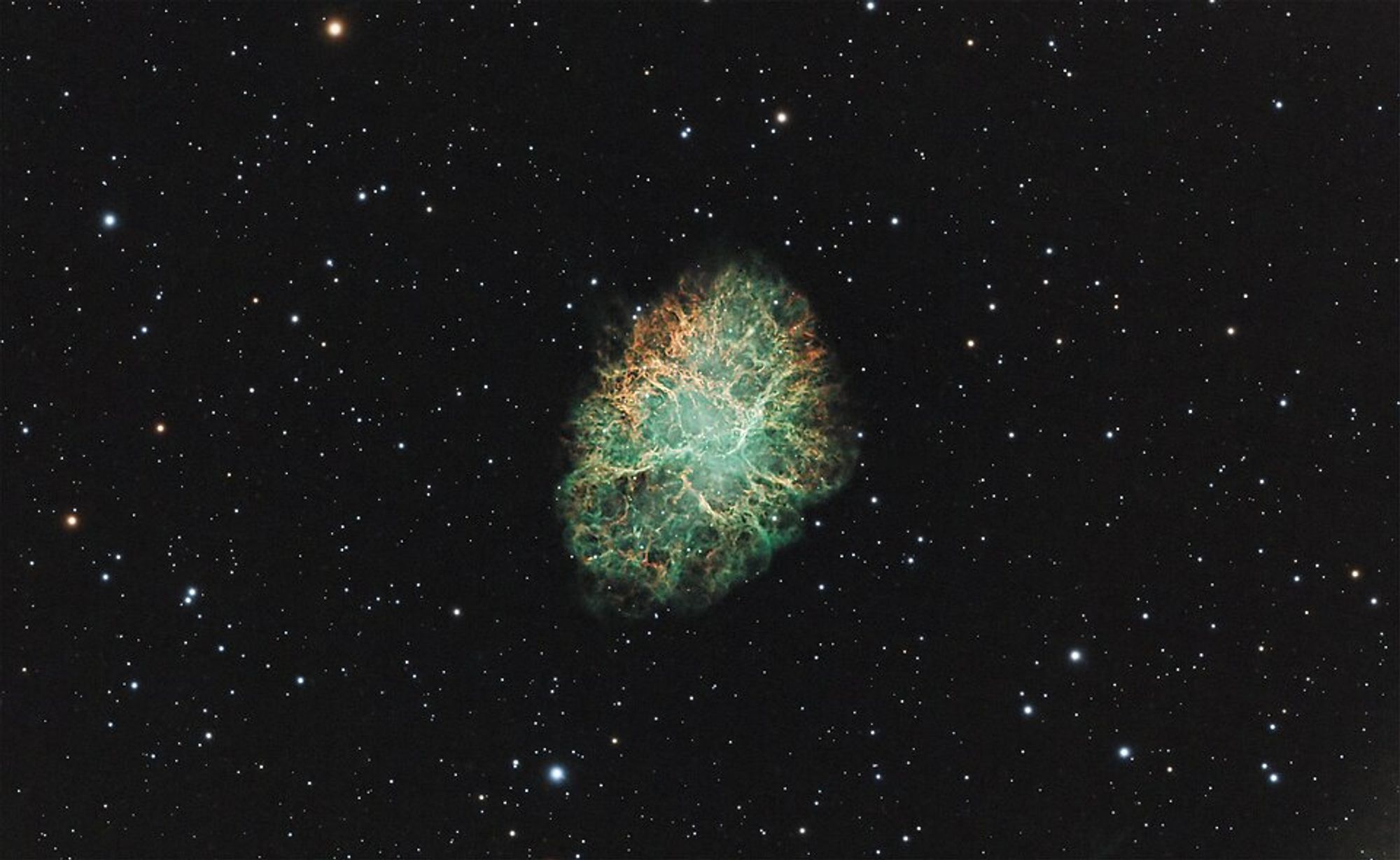
The Crab Nebula in Taurus in December 2023.
Photo: Juan Lacruz. Courtesy of Wikimedia CommonsJuly 7
Last quarter Moon, rising around midnight. On this and all later Tuesdays in July, the AAA (Amateur Astronomers of NY) will offer stargazing for the public at the High Line, 8:30–10 pm. “Meet at the crossroads of Little West 12th and Washington Street, just south of the Standard Hotel. Cancelled in the event of clouds or bad weather.”
July 9
Birthday of John Archibald Wheeler in 1911. Wheeler was probably the most important American physicist of the twentieth century (OK, Richard Feynman fans; you'll have your say later). Wheeler became a teacher and mentor to nearly all American scientists working on general relativity, Einstein's theory of gravity. He invented the terms “black hole,” “wormhole,” and “quantum foam”. And he came up with a single, short sentence that perfectly expresses the basic idea of Einstein's theory and that replaces Newton's theory: “Space-time tells matter how to move, and matter tells space-time how to curve.”
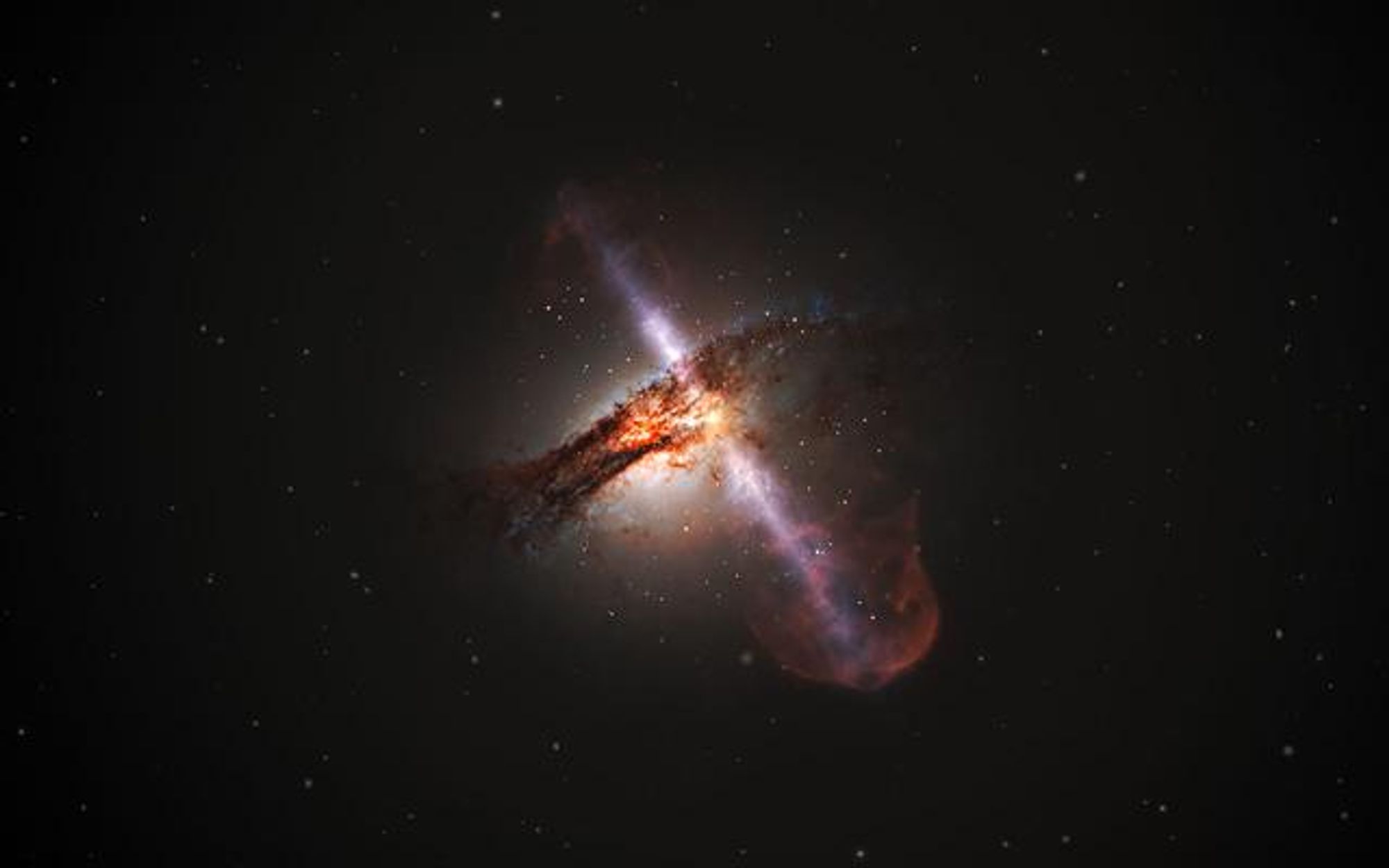
Supermassive black hole captured by the Hubble Telescope, 2017.
Photo: NASA GoddardJuly 8–12
Venus passes very close to the bright star Regulus (the brightest star in Leo, the “backwards question mark” constellation) on these evenings. Look low in the west about an hour after sunset. Pretty nice sight!
July 12
1–4 pm solar observing for the public (at Pioneer Works).
July 14
New Moon. On the nights following (July 15–18), look low in the west for “The Old Moon in the New Moon’s Arms”—also called “Earthshine” by the slightly less poetic.
July 16 (1945)
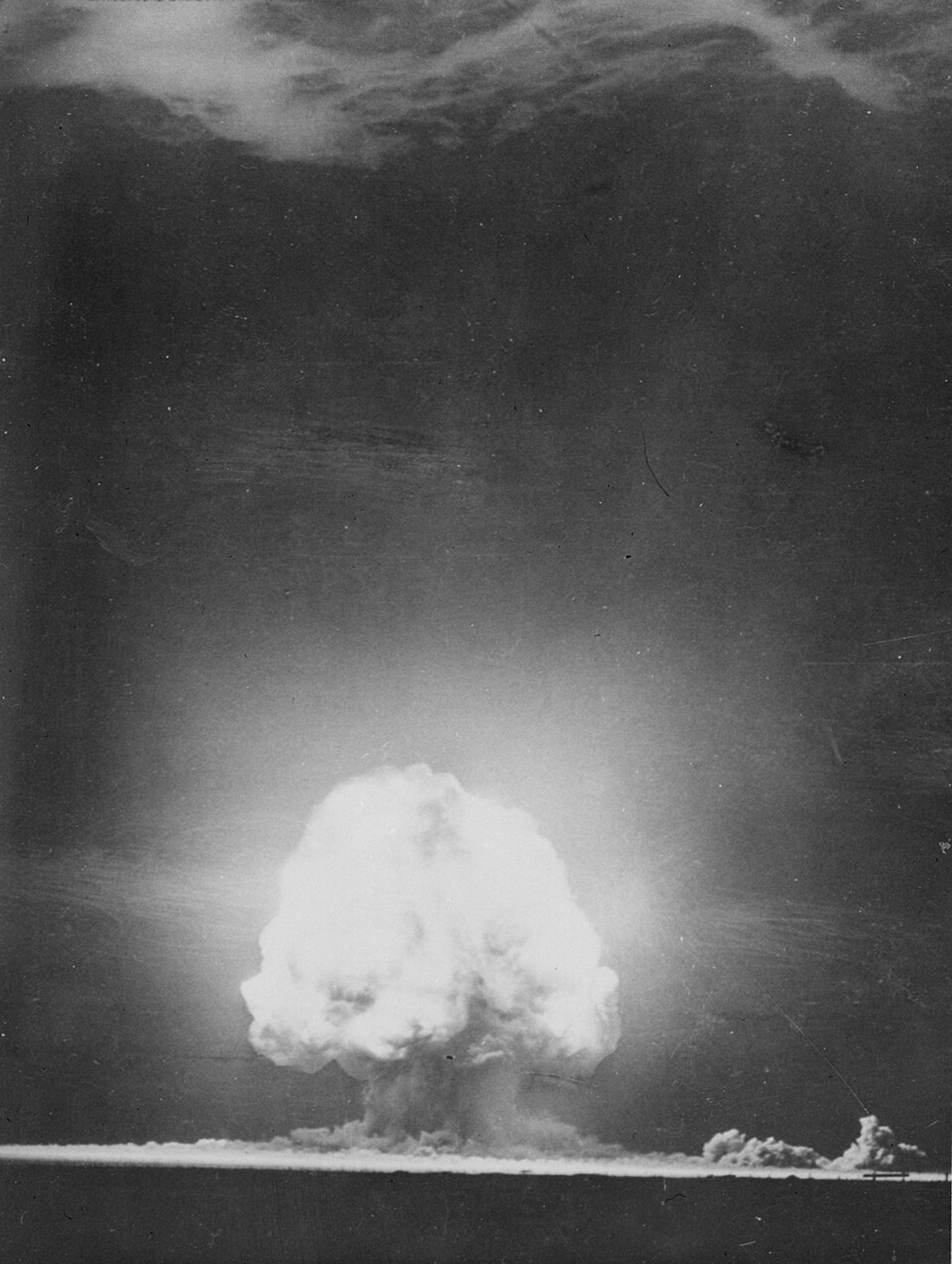
“Day of Trinity”—as it was called in Lansing Lamont’s famous book, to signify the first full test of an “enriched uranium” (U-235) bomb. The test was designed by Kenneth Bainbridge, who, after the blast, was reported to have said to Oppenheimer, “We’re all bastards now.” The bomb itself (“Fat Man”) was then dropped on Hiroshima, with famous and deadly results. Even so, some Japanese physicists advised Hirohito that the Americans couldn’t possibly have enough enriched uranium (it’s really hard to separate U-235 from the much more common but non-explosive U-238) for a second bomb. And actually, they were right. What they didn’t know was that the Los Alamos physicists were preparing a different device (“Little Boy”) using plutonium, which, without any testing, was dropped on Nagasaki three days later, effectively ending World War II.
In my opinion, the best of many books on these matters is Richard Rhodes’ The Making of the Atomic Bomb. Another good one (and shorter) is Brighter Than a Thousand Suns, by Robert Jungk.
July 20
On this famous day in 1969, two astronauts landed and walked on the Moon. The story has been told a thousand times. Less well known is exactly what happened right after the dangerous landing. The original schedule called for the astronauts to catch some sleep before attempting the famous walk. But after all the excitement of the trip and peril of the landing, sleep was the last thing on their minds. Even though they had landed on . . . ahem . . . the Sea of Tranquility.
So NASA changed the plan and said: “OK, do the walk.” Then it was “one small step for a man.” The most-watched live event in television history.
Until, of course, the 2006 FIFA World Cup final between Italy and France, which ended in a shoot-out. Bigger audience—now there was a reason to get excited!
Interesting side note: Of the six American flags planted by the six Apollo missions on the Moon, all are still standing (photographed by Lunar orbiters) except the first, which was blown over by the exhaust from take-off rockets. (The take-off rockets were quickly redesigned to correct this egregious violation of flag etiquette.)
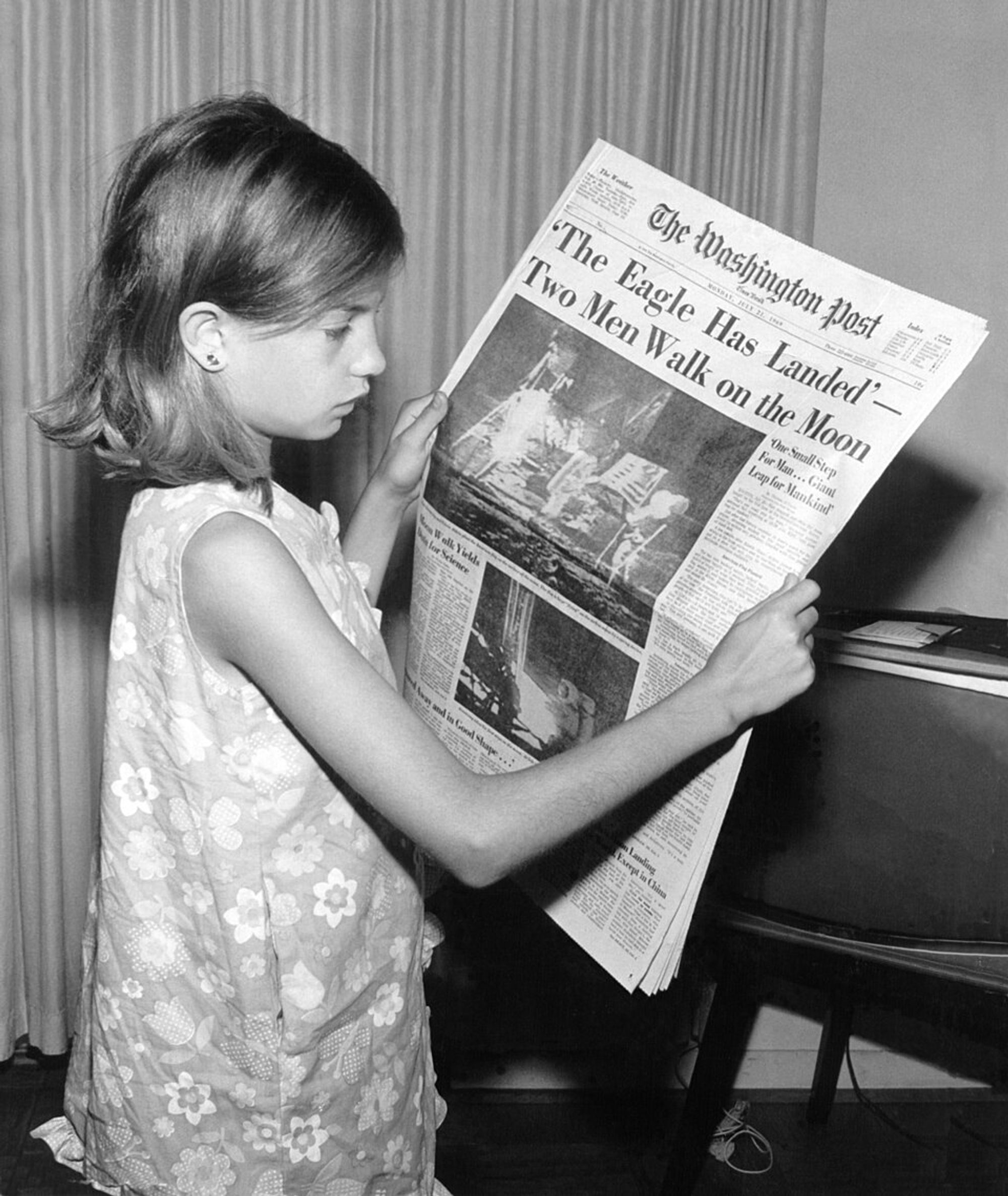
Young girl holding The Washington Post, July 21, 1969.
Photo: Jack WeirJuly 21
First-quarter Moon, high in the south during the evening, and well placed for telescopic observation.
July 29
Full Moon 10:36 am EDT
July 31
Sunrise 5:50 am EDT
Sunset 8:14 pm EDT
August
August 1
Sunrise 5:52 am EDT
Sunset 8:11 pm EDT
August 2–3
The Moon passes just north of Saturn on these nights.
August 1–12
On any clear morning in early-to-mid-August, look for Orion rising low in the east about an hour before dawn. “Ghost of the shimmering summer dawn / King of the winter nights!” My personal favorite season-defining sight in the sky.
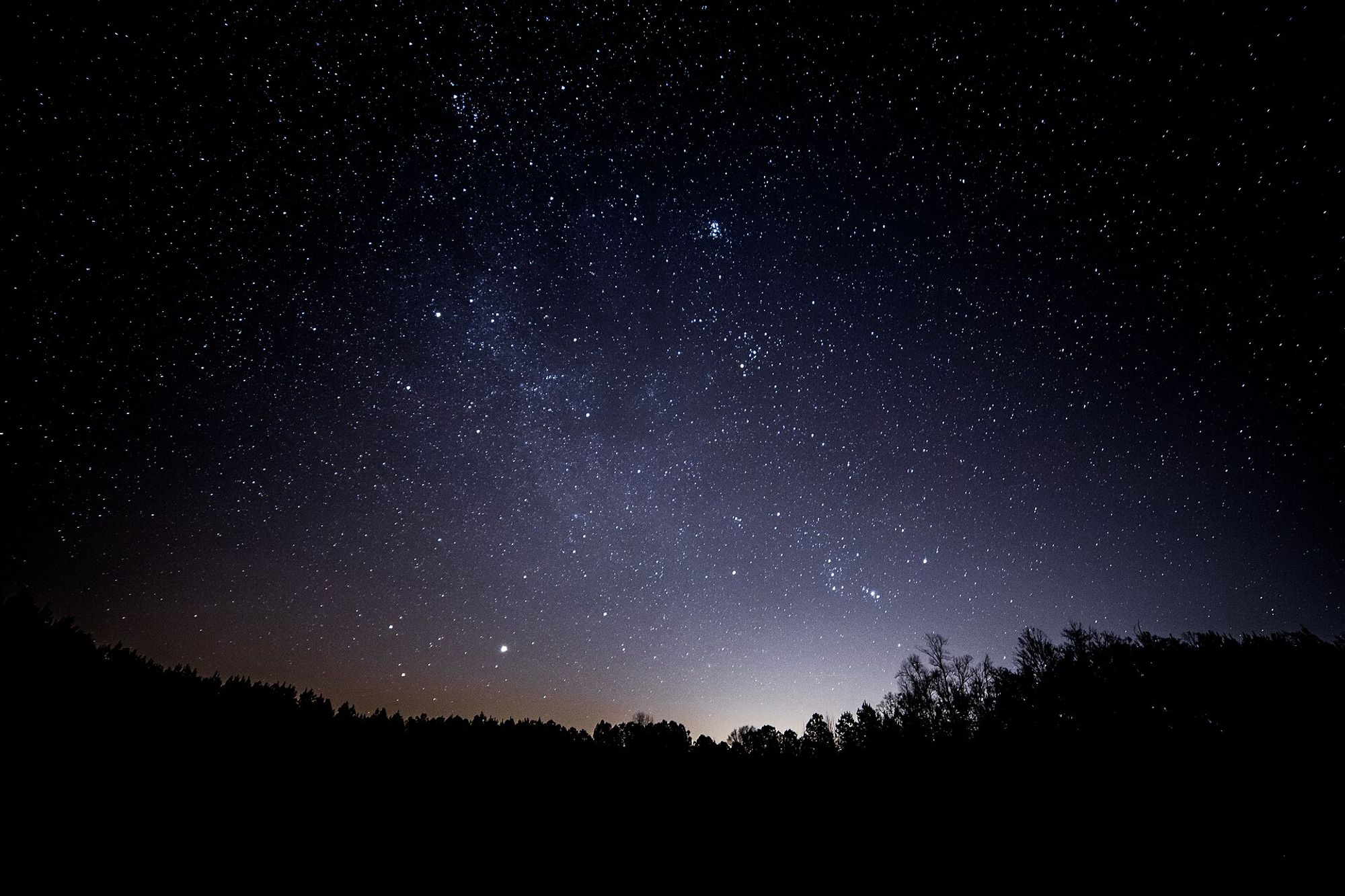
Orion and Jupiter Rising in Macon, GA, 2013.
Photo: Stephen RahnAugust 4
For all later Tuesdays in August: Join the AAA for evening observing at the High Line, 8–10 pm.
August 7–14
Jupiter and Venus, king and queen of planets, stage a little dance low in the eastern morning sky this week. From August 7–10, Venus is just above Jupiter. But Venus, brighter and moving faster, passes Jupiter on August 11. The waning crescent Moon, moving still faster, passes the pair on August 19.
August 10
Today, the Sun enters the constellation Leo. But it entered the astrological sign of Leo 20 days ago, on July 22. What's up with that? Part of this shift arises from minor tinkering with constellation boundaries by humans . . . but most of it is courtesy of the Earth's wobbling axis. In addition to its better-known motions (spin, orbit), the Earth has a third and very subtle motion—the slow precession of its axis, like a wobbling top. The axis now points towards Ursa Minor—in fact, almost exactly towards the medium-bright star Polaris, which we therefore call the “North Star.” But the axis slowly wobbles around the sky, and this causes the seasons to slowly lose touch with the constellations. Our calendar, however, pays attention to seasons, not constellations. So most people who think they're “Leos” are actually “Cancers.” I don't know what the implications are . . . but it doesn't sound good.
August 11–12
All night tonight, the Earth's journey takes it through a diffuse stream of cosmic dust particles which were once shed by Comet Tempel-Tuttle (named after that comet's discoverers). When a comet sheds matter (dust particles), it doesn't really go anywhere—it just wanders off ever so slightly, continuing in roughly the same orbit for thousands of years. Those little dust particles are like the odor particles emitted by humans and detected by bloodhounds. Except that the Earth, unlike bloodhounds, must follow the law of gravity—and only encounters that stream when its orbit intersects the stream's orbit, in early August.
The Earth encounters the dense part of that stream every August 12, and many of the dust particles fall to Earth with a streak of light—a meteor. The meteors appear all over the sky . . . but if you trace back the streaks of light, they all appear to be coming from the constellation Perseus. Hence the name: Perseid meteor shower. It’s the most reliable of the annual showers, and many stargazers plan summer outings to watch the Perseids. Fortunately for us in 2026, it coincides with New Moon—so, barring clouds, conditions will be ideal for seeing meteors. Get away from city lights, dress warmly, and observe—all over the sky—from midnight to dawn. Preferably with your pals, to keep spirits high. Peak night is Aug 11–12, but a day on either side would be fine.
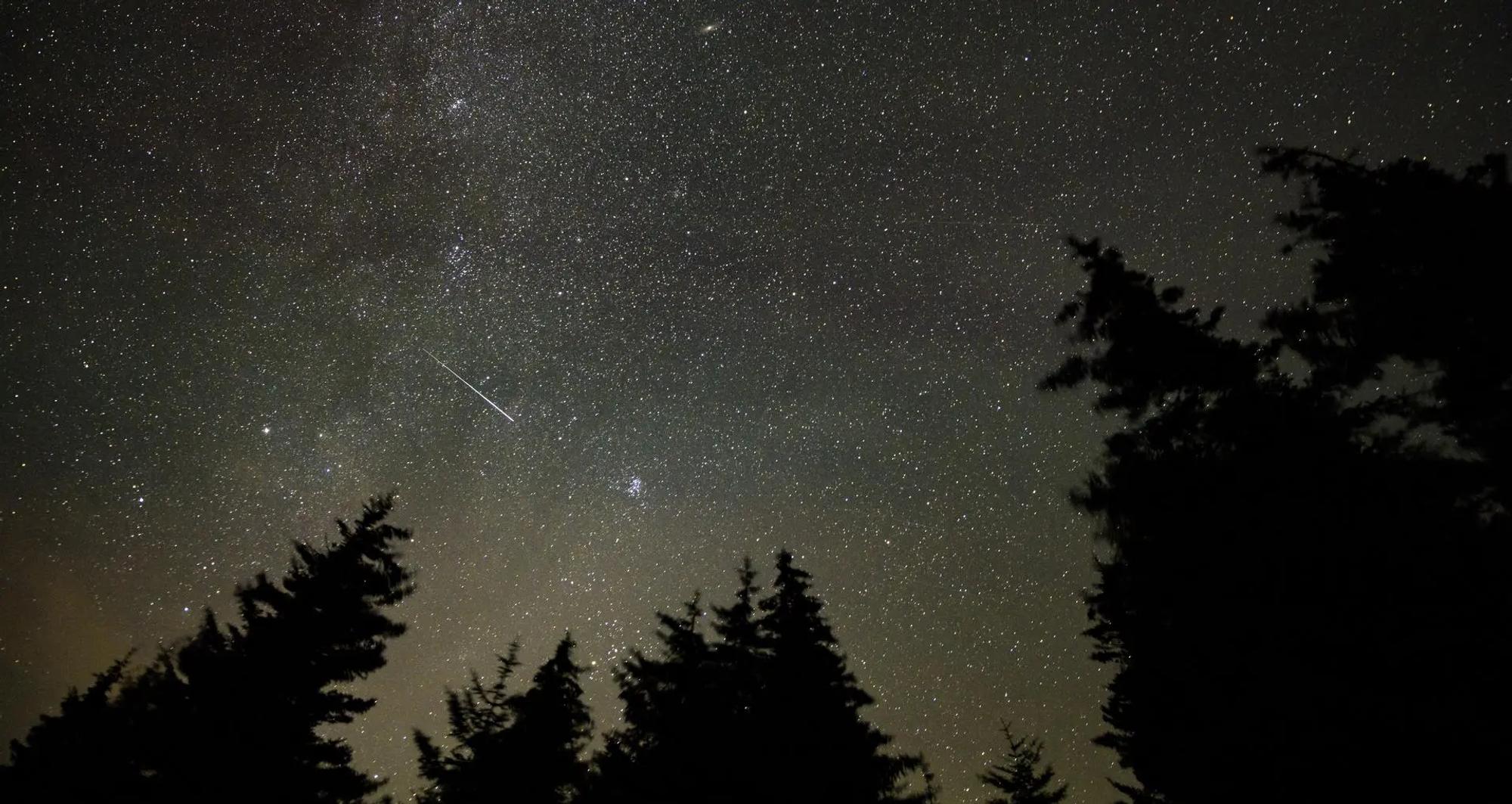
Perseid meteor shower in 30-second exposure, 2021.
Photo: NASA/Bill IngallsAugust 12
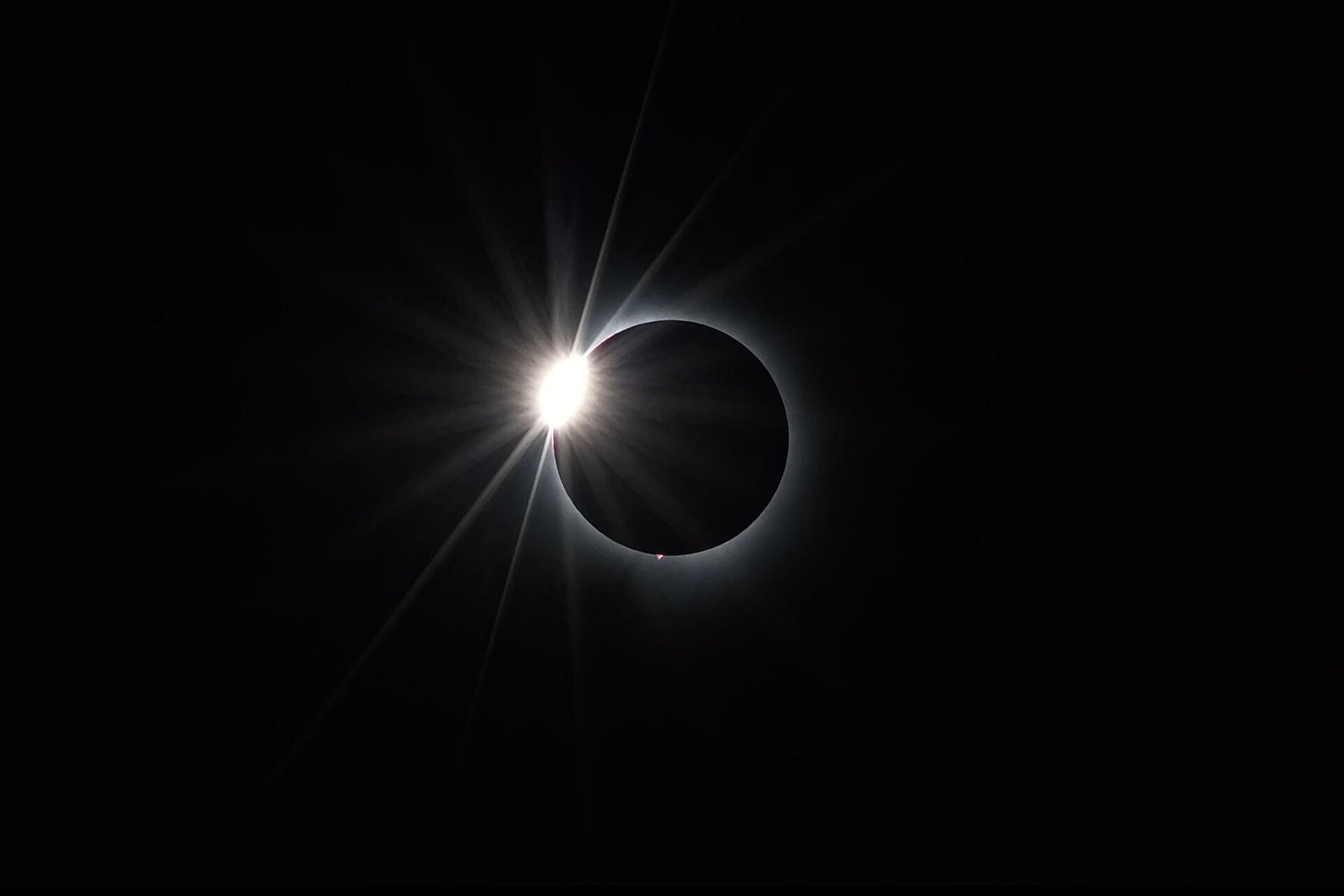
11:36 am New Moon. Total solar eclipse, visible in Iceland, around the North Atlantic, and (near sunset) in northern Spain. Many organized expeditions—some by land, some by sea, some both. Most cost the big-bucks . . . but maybe you can find a last-minute bargain.
August 13–16
STELLAFANE! Over the last 70+ years, this has been the largest gathering of amateur astronomers in the U.S.—and it gets better every year, except when plagued by rain (or COVID, or a full moon). It’s held in the small town of Springfield, Vermont—or more precisely, on a hill overlooking that town. There are many, many events for astronomers of all ages and skill levels—see Stellafane.org. One warning: Hotel and dining facilities are sparse in this area, so many participants bring campers or tents and prepare their own food. Some will doubtless be sharing photos and stories from the August 12 solar eclipse.
August 18
On this day in 1868, one of the most historically important solar eclipses was observed in Thailand. During totality, several teams of mainly British astronomers (but including, oddly enough, Thomas Edison) took spectral photographs of the Sun’s lower and upper atmosphere (the “corona”). They found a yellow emission line which occurred at a wavelength never seen before on Earth—and so they named it “helium” after the Greek name for the Sun. That was the beginning of helium’s glorious history. Today, we recognize it as comprising ~25 percent of the universe. Essentially all the Earth’s atmospheric helium has escaped because helium is so light that Earth’s feeble gravity can’t hang onto it. Mendeleev’s periodic table, for example, has no element of atomic number two. Nor does helium combine with any other element—it’s a “noble gas,” to use the lingo. A major source of helium is the radioactive decay of heavy elements in the rocks of the Earth’s interior. It stays embedded, along with other natural gases . . . until the U.S. stores it in a huge tank in Amarillo, TX. That’s where cryogenic labs get their helium for their zany experiments near zero degrees Kelvin—and maybe the helium for your birthday balloons, too.
August 19
First-quarter Moon, high in the southern sky at sunset—and a glorious target for telescopic observation these few nights (because the 90 degree angle of sunlight casts long shadows).
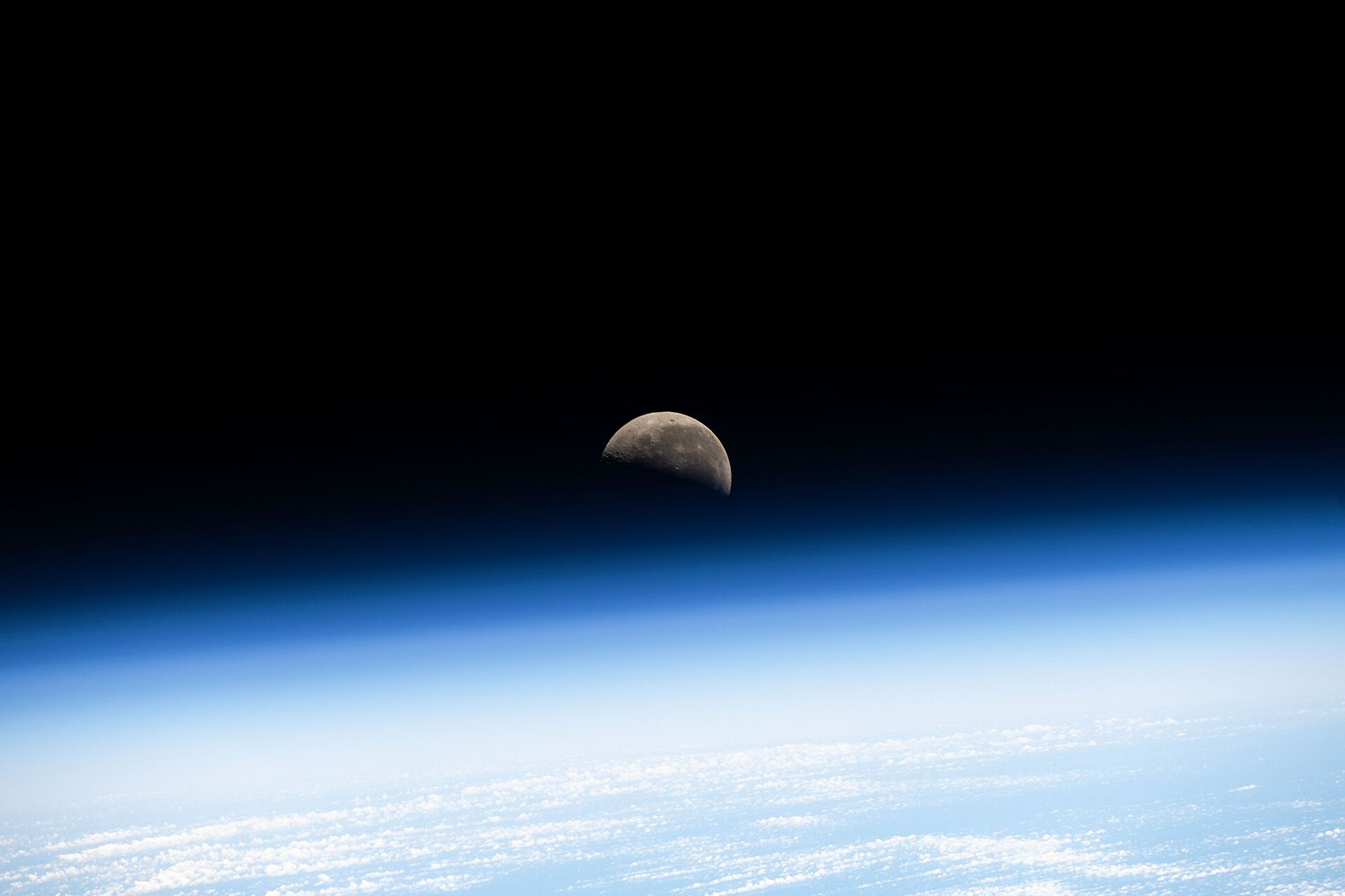
First quarter Moon as seen from the International Space Station, October 5, 2019.
Credit: NASA Johnson Space CenterAugust 19
This morning will feature a very good apparition of the International Space Station (ISS) for NYC observers. At exactly 5:10 am EDT, it’ll appear suddenly in the west, move to the zenith, and move rapidly eastward, disappearing (re-entering the Earth’s unseen shadow) low in the east two minutes later. It’ll be very bright—brighter than any star.
August 21
This was the date of the “Great American Eclipse” in 2017. The moon's shadow swept from the Oregon coast, across the Rockies and the Midwest, before finally heading out to sea near Charleston, SC. Nearly all observers enjoyed beautiful weather and got to witness this once-in-a-lifetime spectacle.
If you spend your life rooted to one spot on Earth, you'll have to wait about 300 years between total solar eclipses—and that's assuming no cloudy days! But fortunately, no one stays rooted in one spot anymore. For the 1925 event (total above 96th Street in Manhattan), the New York Times scolded the Columbia astronomers in headlines for getting the time wrong by four seconds. Maybe the Times was miffed because totality didn’t include them.
If you’re inclined to think about future total solars, here are the ones to consider:
- August 12, 2026: Greenland, Iceland, Spain, or some ship in the N.Atlantic
- August 2, 2027: Spain, most of North Africa, Saudi
- July 22, 2028: Australia, New Zealand
- November 25, 2030: South Africa, Australia
August 25
On this day in 1835, the first installment of the most successful Moon hoax of all time was published in the New York Sun—revealing the amazing discoveries of John Herschel with “an immense telescope” newly installed at the Cape of Good Hope. The author, Richard Locke, reported that Herschel had found the Moon with rivers, abundant wildlife, and humanoids with wings. There were no photographs to prove it (hey, photography was still a decade away), but there were some great drawings.
Locke was no stranger to hoaxes, and hoaxes were not rare in the nineteenth-century literary world. They were great for the sale of newspapers. Most newspapers at the time were sold on the street, with barkers excitedly announcing the juiciest story. This series (there were five more issues) really energized the popularity of the New York Sun. Unfortunately for science, fate intervened. The last issue reported that the telescope was so immense that humans couldn't handle it. Someone trained it on the Sun a week later, in search of yet more amazing discoveries . . . and wouldn't you know it, that burned down the whole observatory. No more discoveries to report. Not even a trace of the telescope for party-pooping investigative reporters to examine.
Edgar Allen Poe was plenty jealous about this. He had earlier published a very similar story, with a traveler flying to the Moon (in a balloon) and finding similar goings-on. But as a story, with obvious satire and no pretense of accuracy, it just didn't have the impact of a real astronomical discovery.
Illustration of the Great Moon Hoax, 1835.
Courtesy of the Library of CongressVignettes of creatures supposedly seen on the Moon, 1835.
Courtesy of the British MuseumAugust 27
On this day in 1883, the greatest volcanic explosion in history occurred: Krakatoa! The blast was heard by humans 3,000 miles away, and the pressure wave travelled around the Earth three times before finally becoming undetectable by barographs. The explosion was 10,000 times larger than the Hiroshima bomb. Volcanic dust was blasted into the upper atmosphere, where it lingered for many months—lowering the Earth's average temperature by about one degree. Krakatoa is part of the “Ring of Fire,” the huge region where the Pacific Plate crashes into plates to its west (Japan, Southeast Asia) and east (California, the Andes, et cetera). Mount Saint Helens (1980) and Pinatubo (1991) are other members.
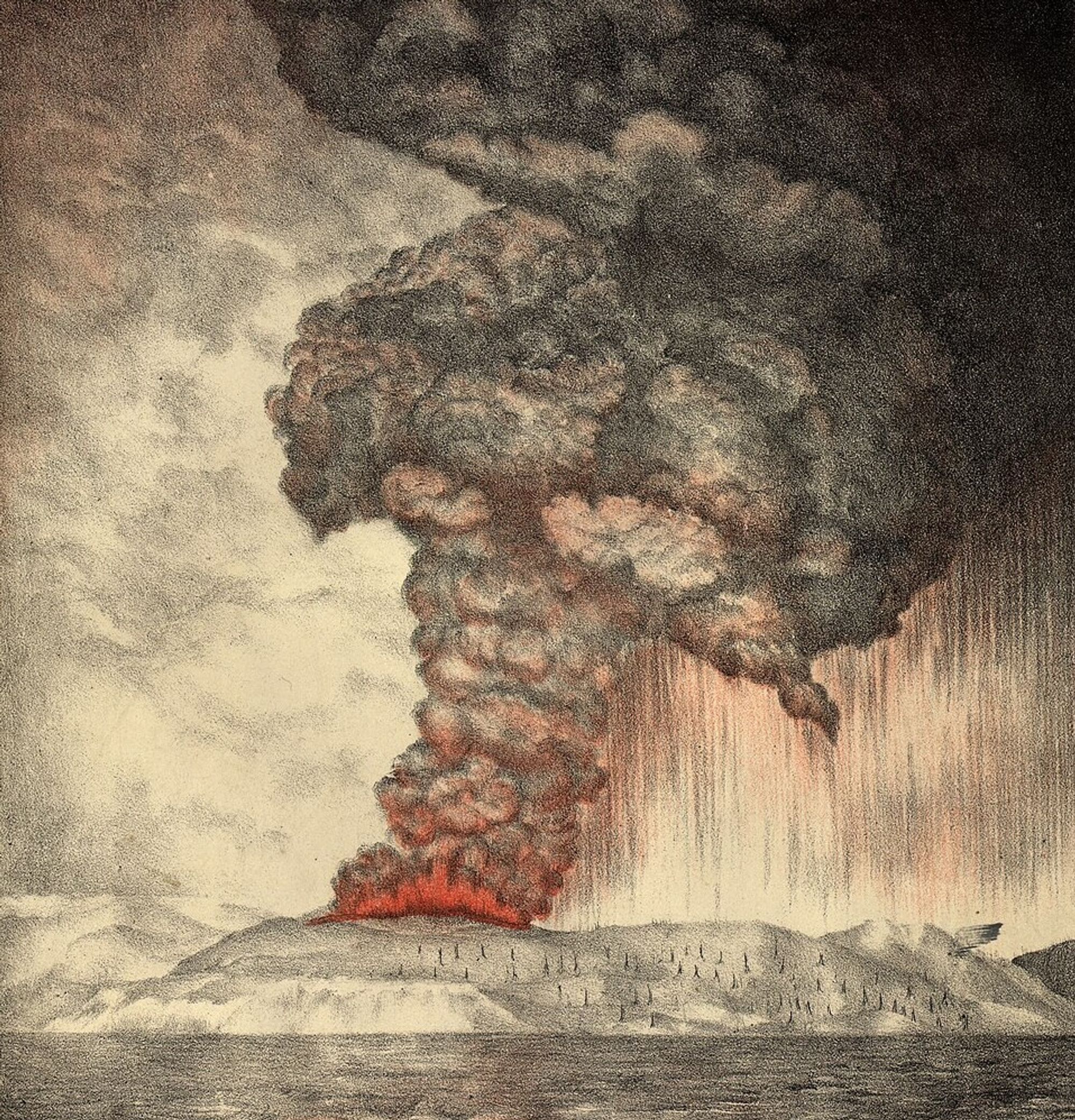
Litograph published as Plate 1 in The eruption of Krakatoa in the Report of the Krakatoa Committee of the Royal Society, Parker & Coward, Britain, 1888.
Credit: Courtesy of Wikimedia CommonsAugust 28
Full Moon 12:19 am EDT. Partial eclipse of the Moon. This one is pretty darn good for Northeast America. The eclipse lasts from 10:24 pm on August 28 to 1:42 am on August 29. It’s a strange eclipse—not quite central, but close (so there may be some of that red lunar color associated with many lunar eclipses). Because of its timing (around local midnight for Northeastern U.S. folks) and season (summer), it’s a great opportunity to watch it progress. As the Moon moves across the Earth’s shadow, it’ll be easy to envision the geometry.
August 29
The exact anniversary of Nova Cygni 1975, one of the most famous “classical novae” in history. I received a phone call on that night in 1975, directing me to go out and look up . . . and behold, I saw an “extra star” in the famous Summer Triangle. (Sometimes it pays to know your constellations.) It erupted from a “blank spot” in prior sky photographs, leading to speculation that it was the long-awaited supernova (none seen since 1604 in our Galaxy). And it was my first day of graduate school at the University of Texas. A few weeks later, I received “telescope time” at Texas’s McDonald Observatory, found a little 3.3-hour wiggle in the light curve, and wrote a research paper about it, plus several others during my years there. It turned out to be closer to an “ordinary” nova (an exploding white dwarf), but with the twist that the white dwarf was strongly magnetic.
Nova Cyg was first seen by observers in Japan, then Korea, then China, Russia, et cetera, as sunset occurred progressively later at those longitudes. By sunset in Texas 14 hours later, at least 2,000 “independent discoveries” must have happened (phone calls don’t count, of course). Sitting up there as a brilliant intruder in the Summer Triangle, it was hard to miss.
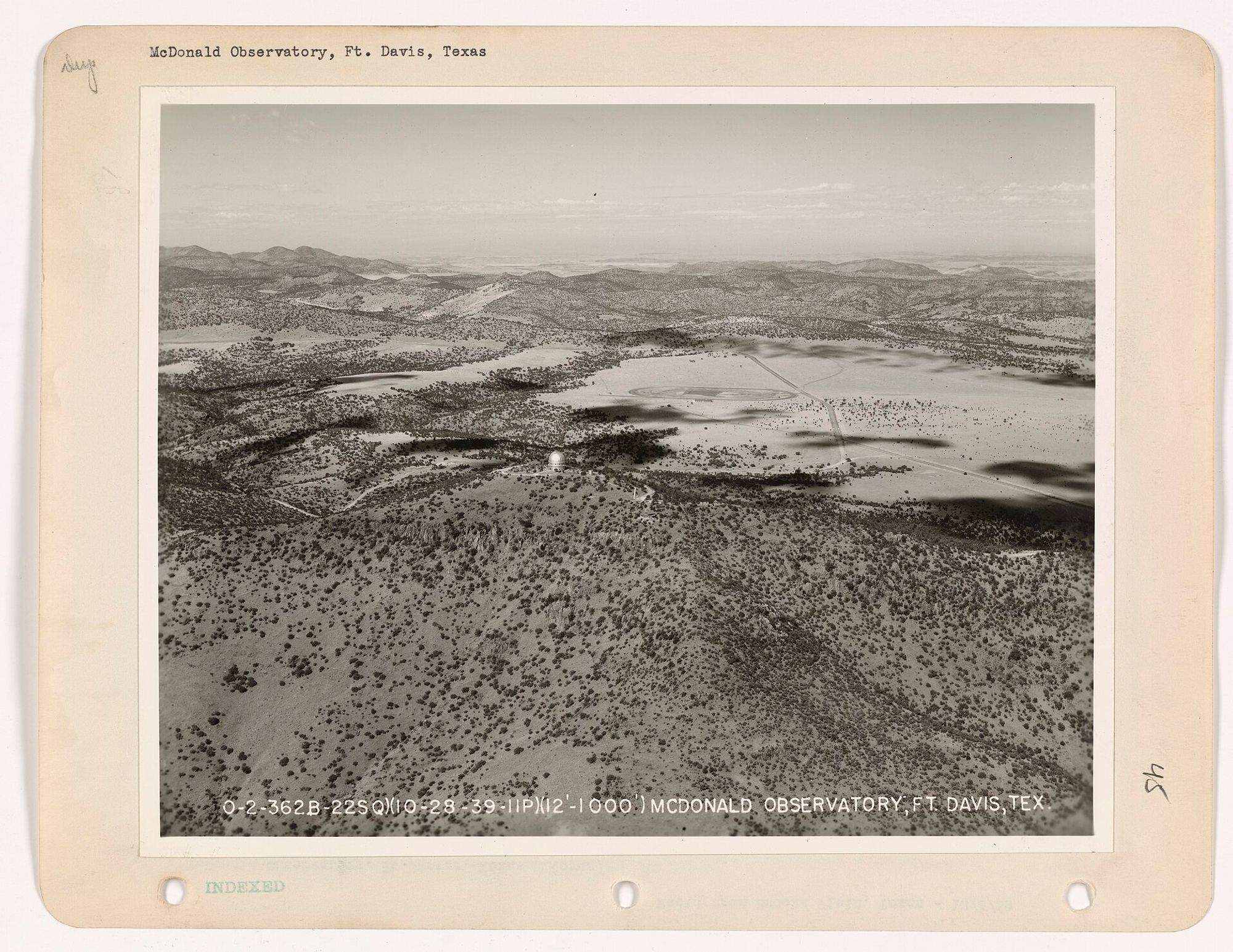
Index photo of McDonald Observatory in Ft. Davis, Texas, 1964.
August 30
Birthday of Sir Ernest Rutherford in 1871. By firing alpha rays (helium nuclei) at gold atoms, Rutherford became famous for revealing the tiny size of the nucleus of all atoms... and for his terrible singing, as he roamed the famed Cavendish Laboratory trying to inspire students with Onward, Christian Soldiers. These experiments stunned the world, because they revealed that atoms mostly consisted, in the solar-system model that became popular, of empty space. Perhaps because of the close analogy to the solar system, it’s still the model often taught in elementary physics and chemistry classes.
In tonight’s sky, look for Saturn just south of the nearly Full Moon.
August 31
Sunrise 6:22 am EDT
Sunset 7:28 pm EDT
September
September 1
Sunrise 6:23 am EDT
Sunset 7:28 pm EDT
September 1
Today, the equation of time is zero. Nowadays, probably 90 percent of astronomy PhDs would have no idea what this even means. But for most of the last thousand years, it would have been elementary to all astronomers, clockmakers, ship captains, navigators, and even some ordinary citizens. Why? Because the only really practical and accurate clock in the natural world (larger than atoms/molecules!) is the Sun. Shadows, and more precisely sundials, were the way you could measure time.
Here's how it goes (in the northern hemisphere). Roughly speaking, the Sun is directly south and casts a shadow directly north at local noon every day. But there are two reasons why this is not exactly true. One, the Sun moves in an elliptical orbit—fastest when it's near the Earth (in January), slowest when it's most distant (in July). Two, it moves in a plane different from the Earth's equator (by 23 degrees). Sundial-makers usually capture these two small corrections (up to 20 minutes) by etching a little wavy curve called the equation of time. But on this day, the corrections are zero, and the Sun is precisely south at noon!
Well, not quite. More precisely, LOCAL noon. But in 1883, the U.S. legislated “Standard Time”, which meant that everybody within ~500 miles east-west of a standard longitude (which for us is 75 degrees west, roughly Philadelphia) must be on that time. NYC is slightly east of Philly, so the Sun is directly south (“crosses our meridian”, to use the lingo) slightly sooner—at 11:56 am. Check out your shadow today—that's when it points exactly north. (But remember, there's another purely legislated correction—Daylight Saving Time . . . so, adding the required hour, it’s 12:56 pm EDT.
Many things labelled sundials are simply vertical or inclined sticks with a horizontal scale for the shadow. Many are sold as small works of art for your garden. These lack all precision, but after looking today at the selections online, they're number one on my birthday wish list.
I'd love to hear about large sundials still up and unmolested in the NYC area. Columbia has a circular slab sometimes called “the Sundial”, but all the essential parts were removed long ago. Just east of Pupin on the Columbia campus is a small, fully functioning sundial. It will keep time for the next thousand years, but no one (not even astronomy students) ever looks at it. “Look on my Works, Ye Mighty, and despair…” (“Ozymandias” by Percy Bysshe Shelley).
September 1
On this date in 1859, the greatest solar flare in history was observed by the British astronomer Richard Carrington. It went on for many days, caused intense displays of the aurora borealis (and australis), and radio blackouts all over the world. If it (now called “the Carrington event”) happened today, it might ground all airplanes for a few days (cosmic rays can be pretty fierce seven miles up).
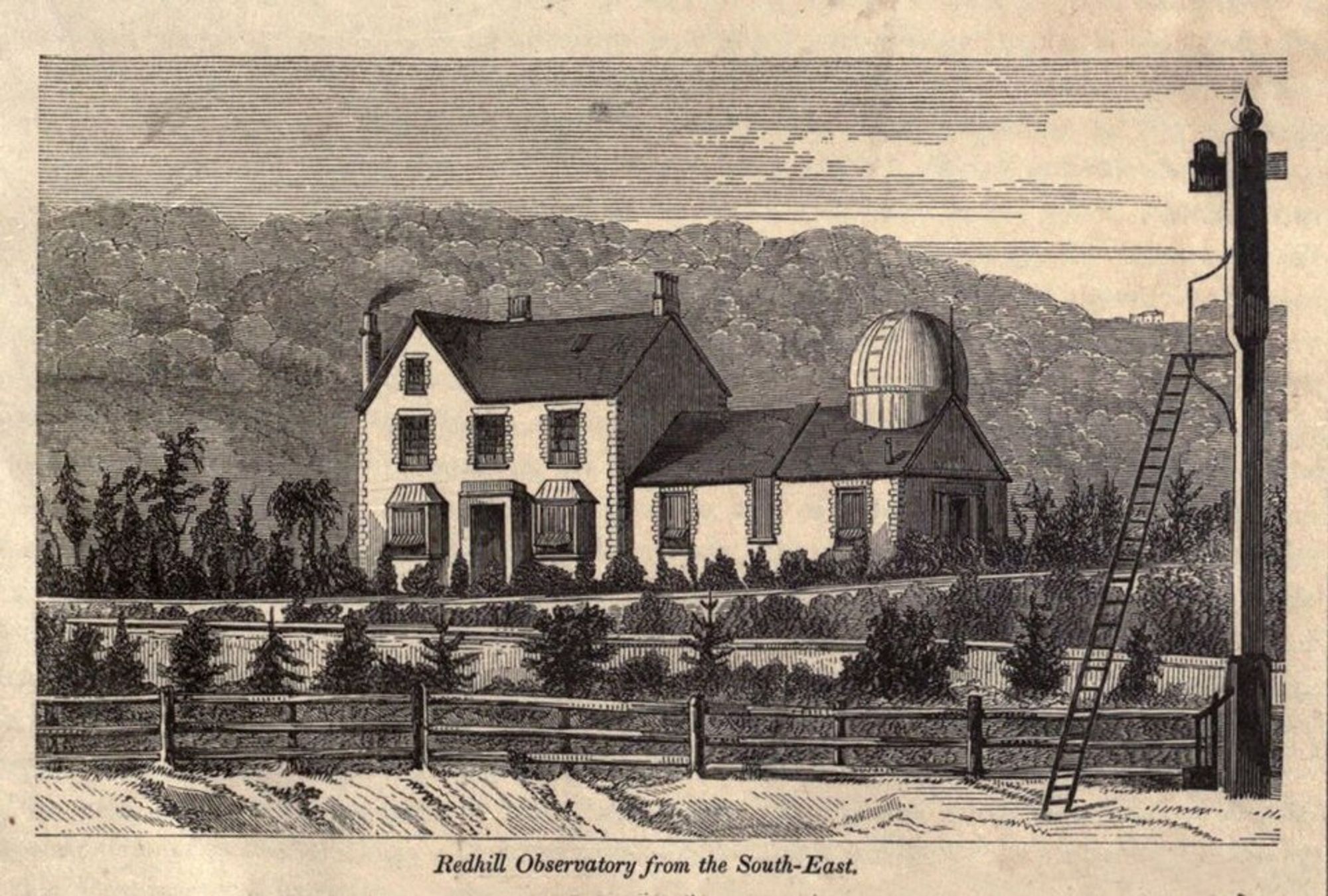
Sketch of the house and observatory of the British astronomer Richard Christopher Carrington, 1857.
Photo: Courtesy of Wikimedia CommonsSeptember 3
The Moon is just north of the Pleiades star cluster in this morning’s sky.
September 4
Last-quarter Moon, rising around midnight. Just north of the M35 star cluster—a pretty good sight in binoculars.
September 8
The waning-crescent Moon is just north of Jupiter in this morning’s sky. Really good sight in binoculars!
September 11
New Moon 11:26 pm EDT. Rosh Hashanah, first day of the Hebrew year 5787.
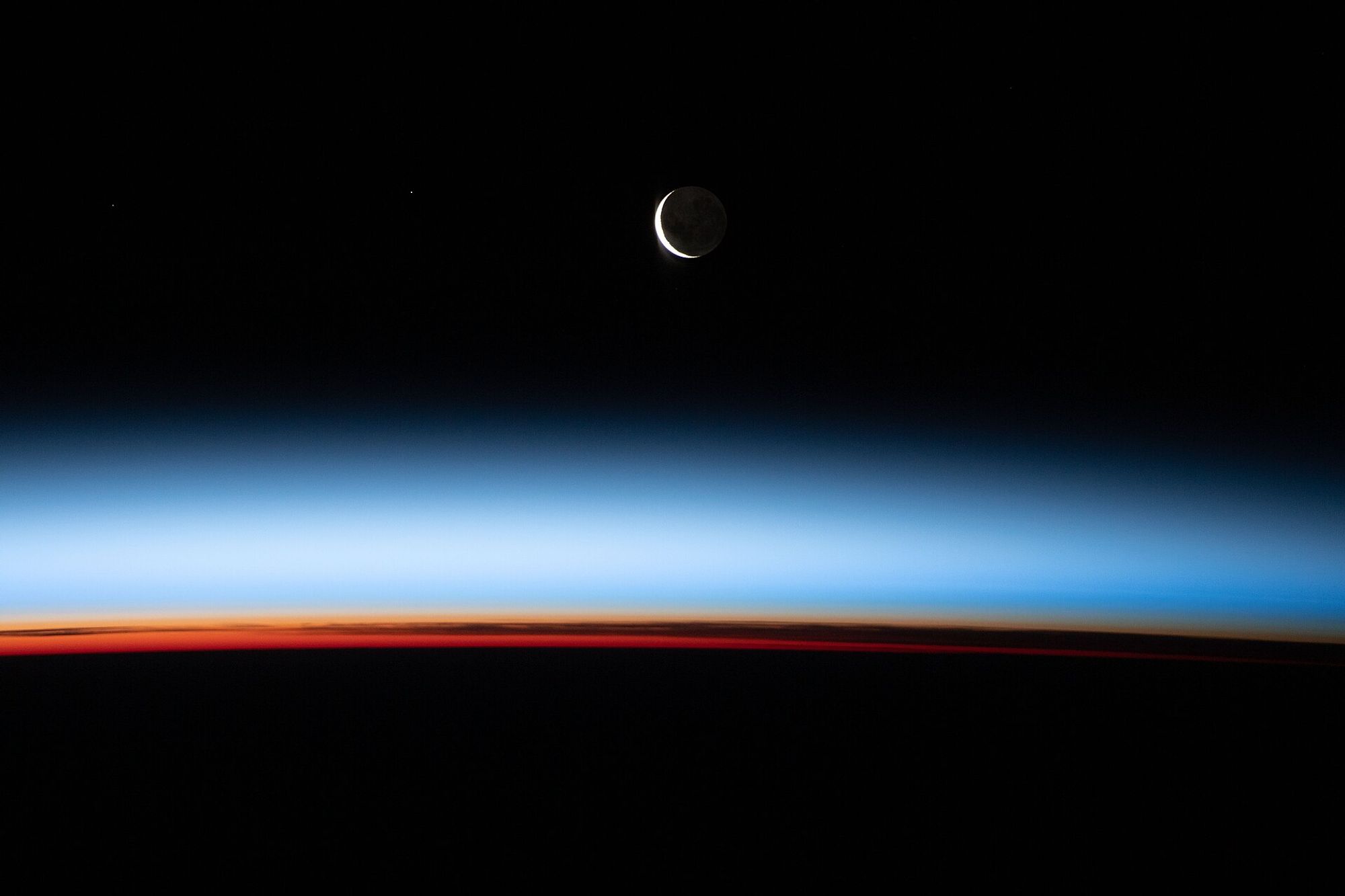
A waxing crescent Moon pictured from the International Space Station, December 6 2021.
Credit: NASASeptember 13–15
The waxing crescent Moon passes close to Venus on these evenings. So find a good spot with a clear view very low in the west (Riverside Park? Pioneer Works?) and see if you can spot Venus, plus “the old Moon in the New Moon’s Arms” (aka “Earthshine”).
September 17
On this date in 1882, the brightest comet in the last 500 years reached perihelion (its closest approach to the Sun). It was 50 times brighter than the Full Moon and could easily be seen in the daytime sky, standing next to the Sun. Unlike practically all comets, it never received a proper name, other than “The Great Comet of 1882.” Like most sun-grazing comets, it broke into pieces after it passed perihelion. No matter how spectacular, all comets are objects of very small mass, and if they get too close to the Sun, the tidal forces can rip them apart.
Later studies of its orbit suggested that this was just a fragment of a yet-bigger comet in the year 1106 . . . and the famous comet of 1965 (Ikeya-Seki, my first) may have been another fragment of the 1882 comet. If so, it may be back in 2048. My guess is NO. In 1965, I heard about the amazing descriptions of Ikeya-Seki by the astronauts . . . and they predicted that it would pass perihelion on a certain October morning. I hiked up to the Harvard Observatory at 5 am and banged on the door until a very annoyed graduate student opened it. He didn’t care anything about comets, and I pushed my way past him. On the roof, at first, I saw no one. Further exploration revealed hundreds of people gathered at the eastern edge. No one seemed to know anything. Then, amid the pre-sunrise glow, a tiny, brilliant object appeared right at the horizon. From it, a faint, linear glow could be seen all the way to the zenith!
The next day, nothing could be seen. It’s possible that the comet’s nucleus was disrupted completely by that super-close encounter with the Sun. That may happen with all sun-grazing comets; otherwise, the sky might be crawling with them.
One moral, among several: Don’t let closed doors get in your way.
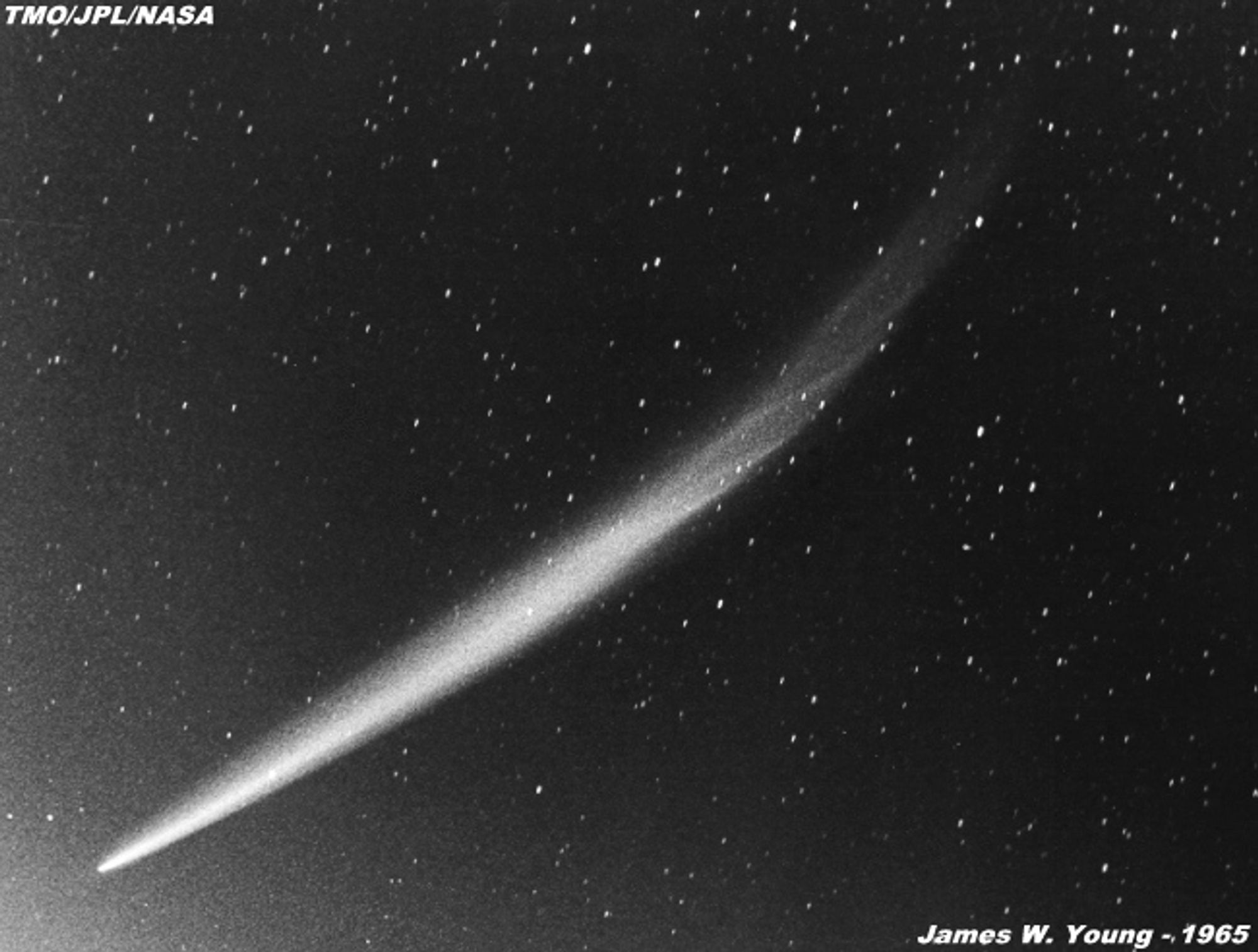
Photo showing the full extent of the Ikeya-Seki comet's tail, 1965.
Photo: NASA/James W. YoungSeptember 18
First-quarter Moon. Always good for telescopic/binocular viewing.
September 20
On this day in 1956, the U.S. Army launched a “Jupiter C” rocket which reached a then-record 700 miles altitude, and could have easily reached orbital velocity if the fourth stage had ignited. However, the War Department (NASA didn't exist yet) had ordered that the fourth stage be a dummy, lest the Army actually launch a satellite—and thereby embarrass the Navy, to whom the satellite mission had been assigned. Over the next year, the Navy's Project Vanguard met with a series of failures . . . and finally came the October 1957 Russian Sputnik launch, which embarrassed (and scared) practically everyone in the U.S. government. A few days later, the Army's Werner von Braun got the call (“Hey, do you guys happen to have another Jupiter rocket lying around?”), which led to the January 1958 launch of Explorer I, the U.S.'s first satellite.
Nowadays, it might be hard to understand why either the Navy or the Army would be involved with rockets. But in the waning days of World War II, Von Braun and his fellow German rocket scientists at Peenemünde (where the V-1 and V-2 rockets were built and launched, mostly at England) hastened to surrender to the American Army (“Operation PaperClip”)—rather than the Russians, who were rapidly approaching from the East with similar intentions.
Apparently, in those days, scientists who were good with the paper clips were highly prized.
September 23
9:04 pm EDT, the fall equinox (or the September equinox, just to be fair to our southern-hemisphere colleagues). Eggs will stand on end today.
Just kidding. It'll be a normal day for eggs. But on this date, day and night are 12 hours long all over the Earth except at the precise North and South Poles (where the Sun is now exactly on the horizon, rolling 360 degrees around as the “day” proceeds). I saw this at age 13, by total accident, when I was flying over the North Pole on equinox day. Sure enough, the Sun never fully rose or set, but just rolled along the horizon during the ~8 hours “over the Pole”. Of course, neither my parents nor I had any idea why!
September 25
Day and night are precisely equal, at 40 degrees north—if, for sticklers, you account for atmospheric refraction and the slightly nonspheric shape of the Earth. My guess is that zero astronomy professors are sticklers to that degree.
September 26
Full Moon 12:49 pm EDT
September 30
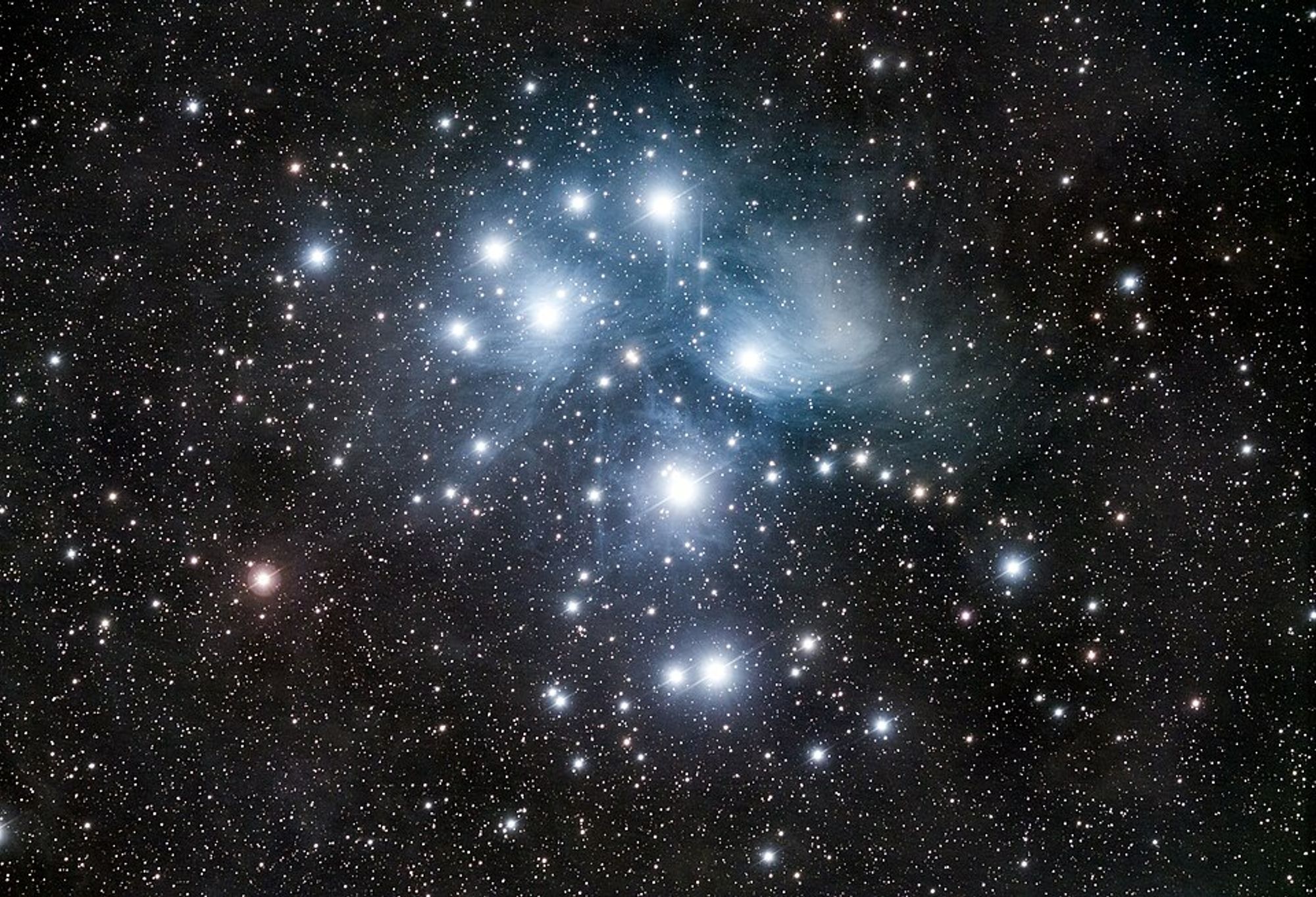
The nearly full Moon is just north of the Pleiades star cluster in today’s early-morning sky.
September 30
Sunrise 6:51 am EDT
Sunset 6:39 pm EDT♦
Subscribe to Broadcast