
Pioneer Works Observatory
In an inspired, Fitzcarraldian ambition, Pioneer Works plans to hoist a stunning observatory atop the former factory originally named Pioneer Iron Works. Like the opera-blaring steamboat that cuts through the Amazon in Werner Herzog’s Fitzcarraldo, the rooftop observatory will be a beacon of culture for all. The centerpiece will be a restored antique telescope of exceptional provenance. Built at the peak of telescope manufacturing in the 1890s, the nearly fifteen-foot long telescope retains the original hand-ground lenses of remarkable quality. The detailed and impressive mechanicals are also all original and traceable to their famed manufacturers. The telescope is an enthusiast’s delight: a phenomenal, historic, museum-quality artifact.
The Pioneer Works Observatory represents a celebration of culture for all. In nineteenth-century America, astronomical observatories had become something of a craze. Despite an intriguing history of bold attempts to manifest a grand observatory in the bustling metropolis around Brooklyn and Manhattan, none succeeded. In 1847, leading Brooklynites declared they would build in haste an observatory superior to any in the world. That ambition did not come to fruition. A hundred and eighty years on, Pioneer Works will mark the culmination of this history with New York City’s first public observatory.
Both a museum-quality artifact and a working instrument, the telescope and the aspired observatory represent an enduring belief in the transformative power of knowledge and public access.
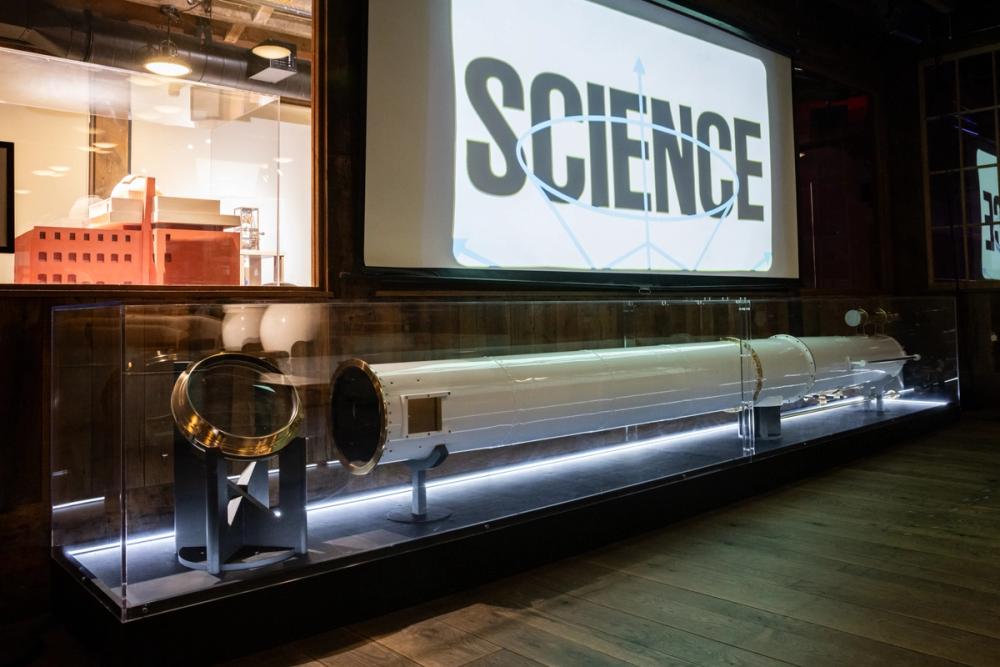
History of the Pioneer Works Telescope by Bart Fried
Our observatory advisor and historian Bart Fried stewarded the acquisition and restoration of the Pioneer Works telescope. He offers this history of the telescope.
The 1895 Refractor was a gift of the New York banker and benefactor Emerson Osirus McMillin to Ohio State University. It features a 12.5 inch achromatic lens made by the John A. Brashear Company, with a focal length of approximately 4,500 mm (f/14.2). The massive cast-iron pier, equatorial mount, and optical tube assembly were produced by the Warner & Swasey Co., Cleveland, Ohio., which also supplied the weight-driven clock drive for continuous tracking of the night sky.
For 85 years at Ohio State University, the telescope supported major astronomical research. Professor Henry Curwen Lord used it with a Brashear spectrograph to determine stellar radial velocities and to conduct pioneering studies of spectroscopic binary stars. Later, Professor Edmund S. Manson Jr. used the instrument for astrometric work on asteroids, occultations, double stars, solar motion, and globular clusters. Throughout the first century of its working life, the telescope also served as a key teaching tool for students and a centerpiece of popular public observing sessions. The telescope comes to us from the Ballreich Observatory in Tiffin, Ohio, where it had been refurbished and used for generations of public viewing. After searching around the globe for a telescope, we found this remarkable instrument and shepherded a full restoration by Alan Sliski & Sons before arriving at Pioneer Works in September 2025. As we raise funds to bring the rooftop observatory to life, we also honor the telescope’s past. First lit by Professor Henry Curwen Lord and tended by astronomers, students, and the public for more than a century, it has always been an instrument for discovery, education, and shared curiosity. Now, the telescope rests in wait for its next chapter.