The Burn of Stigma
Rare Ongoin Ion (detail) by Jordan Eagles, 2023.
Courtesy of the artistAs he entered the temple, the air felt different. Ken pulled down his scarf and took in a long, deep breath. A woman nearby collapsed to her knees in tears, leaving a teddy bear on a shelf; a temple guardian placed a hand on her shoulder. The cries of others moved through the space and coalesced into a song of release as Ken carefully placed his folded uniform at the sanctuary’s center.
That night in August 2016, the temple in Nevada’s barren Black Rock desert was set ablaze. The sun had set hours before, scattering hues of red and orange that matched the dancing flames of fire across a sea of dilated pupils. Ken Pinkela stood still, dust and tears in his eyes. He watched as his uniform was engulfed in flames; a patch with a black oak leaf burned, stripping him of his rank as lieutenant colonel. Then went the patch that assigned him to the military district of Washington. The Pentagon. As his uniform continued to blaze, a flame that slowly erased the letters U.-S. A-R-M-Y, the stars of the flag that had once branded him danced with fire before becoming the black ash that settled into the desert dust.
Ken’s uniform was camouflage, but it did not hide him from his enemies. Earlier that week, he’d thought about the last times he’d worn it: when he entered prison, and, the final time, in 2013, as he left.
*
Back in the ’90s, Ken Pinkela, then 30 years old, had run the show as an administrative officer at Fort DeRussy in Honolulu. When no one was watching, he’d slip away from the base by Pearl Harbor to take his customary walk, always toward the same banyan tree, whose thick roots and branches stretched over Hula’s, a legendary gay bar that came to life in 1974.
Ken cherished the part of his week when he could hang up his uniform. For a few hours, it did not define him. He could show off his tan while flexing his muscles—a bodybuilder since joining the U.S. Army, he was the light heavyweight champion of the Armed Forces. With a few good disco moves, he sang along to Whitney Houston as he enjoyed his favorite fruity cocktail. The colors of his mai tais mirrored the setting sun of Waikiki.
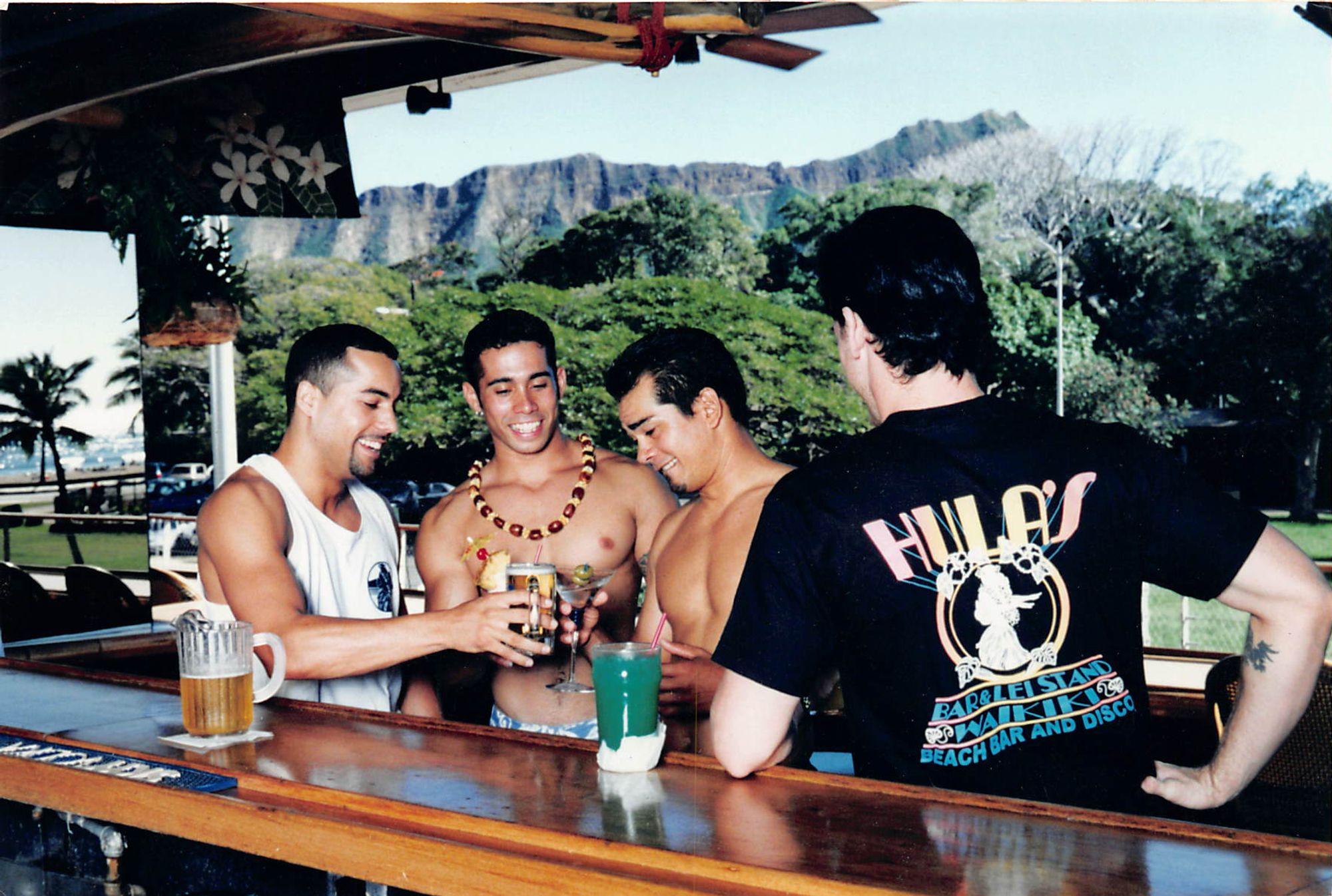
Assorted images from yesteryear at Hula's Bar and Lei Stand in Waikiki, Hawaii.
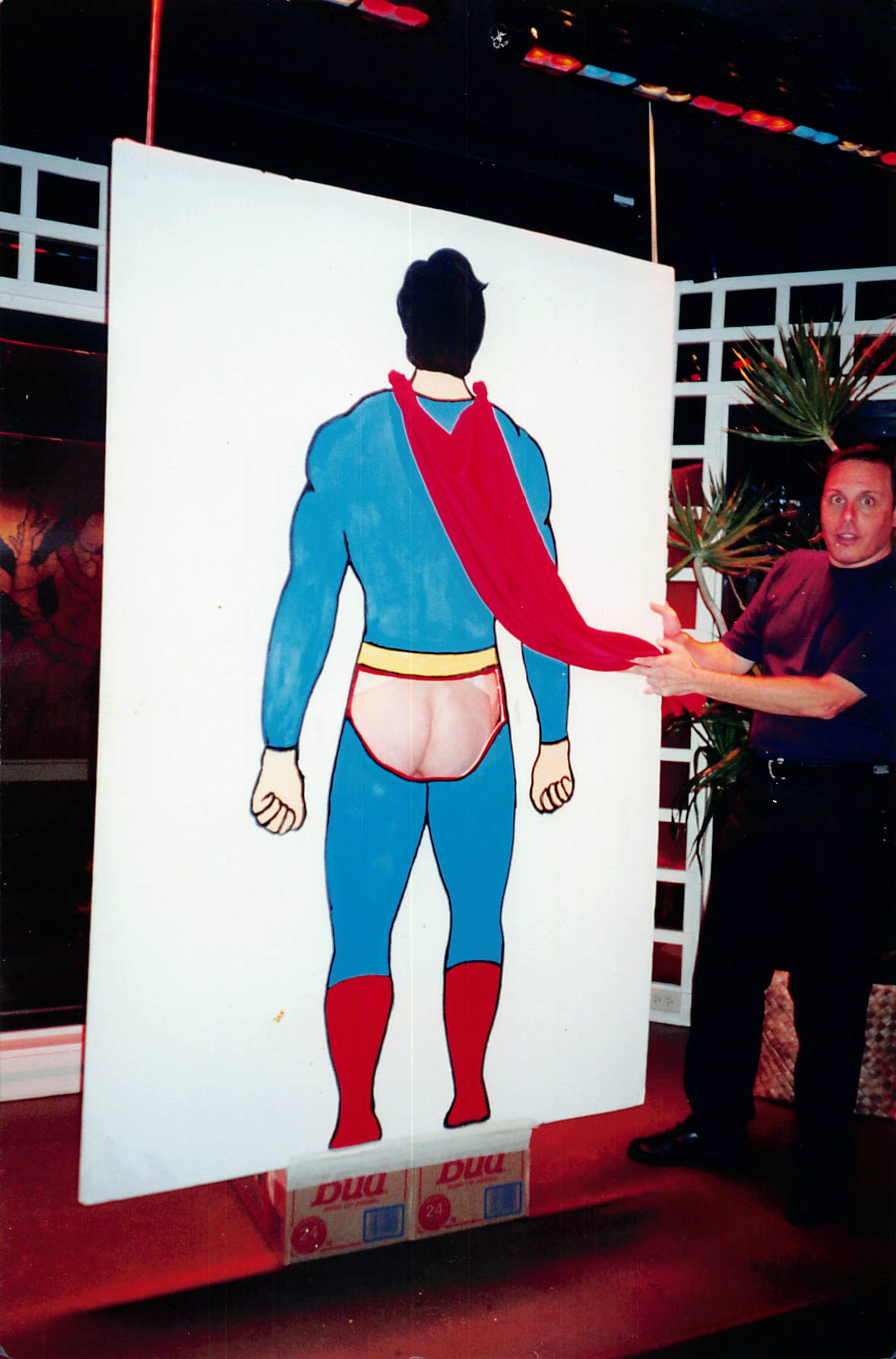
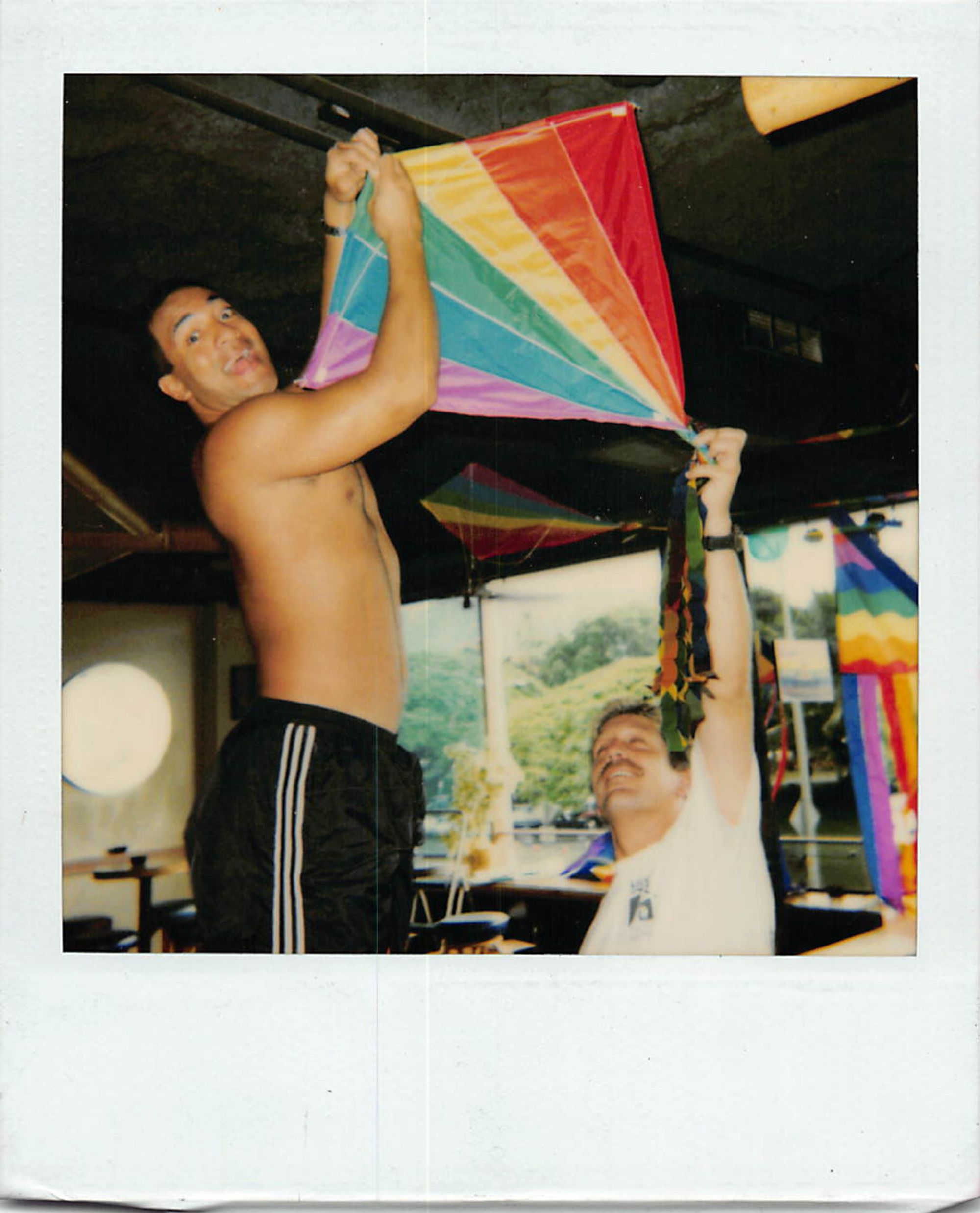
He would nod at other service members—a Marine, or a boy from the army, the Coast Guard, the Air Force or the Navy—each recognizing the same risk in the other; just being there required calculation. Ken would watch over his shoulder, pause, and study the entrance before slipping under the white arch of Hula’s, careful not to be seen. He hid his homosexuality from his family and even, in ways, from himself. He learned to compartmentalize to survive. Over time, the act settled into him until it no longer felt like performance. Ken had a mantra he repeated in his head: “I am a heterosexual soldier but a homosexual man.”
Ken was in a monogamous relationship with a young man who traversed the seas in a submarine for months at a time, so at Hula’s, he built a circle of friends. They learned to watch closely. Sometimes a man would arrive in a shirt just a little too loud, his attention too insistent, his movements slightly off. The rhythm would break. A look would linger too long; desire would feel rehearsed. And that’s when his friends would call in the gay mafia. Ken and others would surround the interloper and press him, gently but directly. “Why are you here?”
Over time, the pattern became clear. An Air Force commander was running sweeps, sending in undercover Military Police to lure service members outside the bar, beyond the limits of its private property, where they could be arrested. The instruction was blunt: get the faggots. The method was simple: seduce, isolate, expose. Ken had friends who were arrested, dishonorably discharged, and never heard from again.
Between 1994 and 2011, under the policy known as “Don’t Ask, Don’t Tell,” more than 13,000 members of America’s armed forces were discharged for their sexual orientation. At Hula’s, Ken and his friends could feel the number growing, one encounter at a time. Sometimes, when pressed, the undercover MPs would break. They would admit who they were, who sent them, and the quota they were meant to fill, even if no one was supposed to ask, and they were not supposed to tell.
I did not know that living with HIV could send someone to prison until I heard Ken deliver a keynote address during a conference on HIV and AIDS at the Rijwiel en Automobiel Industrie building in Amsterdam in 2018. HIV is criminalized in more than 30 U.S. states through laws that penalize HIV non-disclosure, weaken privacy protections, enhance criminal penalties, and in some cases, require sex offender registration. These laws are widely criticized as discriminatory, stigmatizing people living with HIV and ignoring modern scientific evidence about how the virus is transmitted. I spoke with Jordan Eagles, whose exhibition Bases Loaded is now on view at Pioneer Works. The show is the most recent in his exploration since the 1990s of the aesthetic qualities and political implications of blood, with the Mets blood donation drive at Citi Field as a jumping off point. Eagles’ work is literally made of the fluid, dripped and pooled in layers of resin. At Pioneer Works, his sculptures are shaped like base plates, while Mets T-shirts hang nearby, splattered with blood. Eagles, who is a lifelong Mets fan, is prohibited from donating blood due to medical policies that discriminate against gay men, and his art explores this broken sense of belonging. Jordan told me that “in the case of Ken, he so bravely wanted to serve his country and was willing to die for his country—yet look at his unfortunate and unjust set of circumstances. In my exhibition, many of these themes are interwoven in an abstract manner.”
Ken has indeed lived this reality to an extreme. His story is a stark illustration of how belonging to a community—in his case, a community whose membership he paid for with blood, sweat, and tears—could be violently revoked because of what his blood contained, or was thought to.
*
During those years in Hawaii, Ken’s place of true calm was on the ocean floor, sitting in a meditative state, adorned with oxygen tanks and submerged in the silence of the sea. He’d sit there for hours without a wetsuit, surrounded by a rainbow of untouched coral as gentle waves passed over him, sparkles of sunlight permeating their surface. Only in this calmness did the soundscape of the reef come alive, the click, click, click of clam shells under the sand, the crackling of a shrimp claw, or the grazing of a sea urchin. Baby sea turtles would settle into his lap, finding respite in his warmth, and he’d sit as still as possible as an octopus inspected him, curious tentacles studying his back.
One day, when Ken resurfaced, he thought it odd that he saw a couple guys surfing nearby. The surfers usually stuck to Sunset Beach. This far up, the North Shore was too shallow; the waves broke on the coral reef. “They must not be from around here,” he thought. Ken watched as one of the boys caught a wave, leaning into its barrel, and when the ocean took him, his board disappearing, he was slammed into the coral and failed to resurface. As a rescue diver, Ken immediately went into action, flipping his fins as fast as he could. The reef was so shallow at this point that it shredded Ken’s skin; he was slashed. When he got to the boy, he was unconscious and bleeding profusely from wounds inflicted by the coral and rocks.
“Come on, kid, come on,” Ken yelled as he grabbed the boy, about 20, dragging him through the water toward the shore. As he approached the wave break, he lifted the boy into both of his arms to carry him to safe ground. Others on the beach called for an ambulance. The boy had hit his head, had a lung full of seawater, but Ken saved his life.
In the water, the blood from their wounds mixed.
On his way back to Iraq, Ken tested positive for HIV.
*
On June 29, 2012, the day of his 45th birthday, Ken adjusted his collar. His palms were already wet. In fact, he’d broken into a cold sweat each day as he sat through the long hours of court martial proceedings at Fort Lesley J. McNair, in Washington, District of Columbia. What hurt him most was the impact this trial had on his family as they eagerly waited for him to be free.
No exhibits were entered. No physical evidence was shown.
Ken listened as his accuser said, verbatim, that he was liable for “potentially almost exposing me to a deadly virus.”
Potentially. Almost.
“I’ll offer my blood,” Ken told the Army. Sequencing the virus could establish the presence or absence of a phylogenetic relationship between his strain and his accuser’s, showing whether transmission had actually occurred. But the Army refused.
Each time his accuser took the stand, his story was a little different—he’d forget key prior declarations, even when shown the transcript of his earlier statements. With each shift, each omission, Ken knew the accusations were ludicrous, but as he watched the story take shape before him, his nervous system began to unravel.
The lawyers redefined him: “Lieutenant Colonel Pinkela was, himself, the weapon.” The judge made him indistinguishable from the disease: “Embedded within the word ‘HIV’ [is the implication that it’s] likely to produce death or grievous bodily harm.” It didn’t matter what Ken did or didn’t do with his body; the court saw him as a live grenade.
The judge asked all parties to rise. Ken stood, smoothing his suit and glancing behind him toward his mother, Brenda. The judge announced, “Lieutenant Colonel Kenneth Pinkela, this court-martial finds you, of the specifications of all charges: guilty.”
Following Brenda’s gasp, an eerie silence filled the courtroom. Ken closed his eyes and imagined sitting at the bottom of the ocean, surrounded by coral and sea creatures. He wondered if he would ever be able to experience that peace again.
Even after being found guilty, the judge let Ken go home with his mother, rather than keep him in jail overnight awaiting sentencing. The prosecution asked for a 10-year sentence. Brenda went straight to Ken’s room to collect his gun.
The next day, the judge sentenced him “to be confined for one year and to be dismissed from the service.” Ken was charged with two specifications of assault with the means likely to produce death or grievous bodily harm, one specification of sexual contact causing bodily harm, two specifications of violating a lawful command, two specifications of reckless endangerment, and two specifications of conduct unbecoming an officer and a gentleman.
Ken was handcuffed in camouflage, then stripped of his uniform and given a new one. From camo to solid brown.

Handcuffed, Ken was escorted past a row of people convicted of murder and rape and was immediately thrown into solitary confinement for 10 days, without the antiretroviral medication necessary to keep his viral load undetectable. The only thing he was allowed was a religious text. He’d asked for his pocket edition of the U.S. Constitution, a sort of religious text for Ken, but they refused. “Only a bible.”
He sat there in a concrete cinderblock with a metal bed, a metal toilet, and slamming metal doors, with only an opaque strip of glass, just a few inches wide, to let light in. But he couldn’t see out. Meals were pushed at him through a small opening in his door. No human contact. Ken stared at the wall for days.
He was eventually transferred to O-POD, given a “roommate,” and assigned to floor cleaning duty. It was a far cry from his previous highest-clearance Pentagon job, where he was described by senior Army leadership as one of the very best officers they had ever evaluated, a force management leader whose work would leave lasting impact. Ken and his roommate were the most educated prisoners and held the highest rank. But they were also the oldest, and the other inmates called them the geriatric wing, a designation that still makes him laugh today.
After a series of scribbles, Ken wrote out the phrase he’d learned to know himself by—Kingdom-Phylum-Class-Order-Family-Genus-Species—with a kind of investigative repetition, then the preamble to the Constitution by memory, written 18 times. He tallied and recorded every single time he was frisked or strip-searched, at first in clean, deliberate marks, but soon the tallies unraveled, no longer ordered nor coherent.
The Army had sponsored Ken to study his MBA once he’d tested positive for HIV, in order to elevate him for non-combat opportunities. Given his education, the Commander of Leavenworth assigned Ken to become the English teacher for a GED level course for other prisoners. Through this process, he helped young service members write their clemency letters, which led to reduced sentencing for many of his students. When it came time to write his own, President Jimmy Carter, who was a family friend, wrote Ken a letter of support: “I have reviewed the facts pertaining to the court-martial of Lieutenant Colonel Kenneth A. Pinkela and request you grant him mercy by disapproving his dismissal from the U.S. Army due to his record as a good soldier [and] citizen.”
After 272 days, when Ken was released early for accumulating good conduct time, he put on his camouflage one final time.
*
As Ken sat at the front of my Life Science classroom at New York University last spring, wearing a T-shirt that read HIV IS NOT A CRIME, I watched the faces of my students. Some reached quietly for tissues, others wiped their eyes furtively.
“I wish I was having all the sex they accused me of,” he said, letting the line sit just long enough for a thin ripple of laughter to pass through the room.
“A lieutenant who knew I was living with HIV accused me of infecting him,” he continued. “Someone I never had sex with.”
The room stilled.
“During the trial, my lawyer was given access to his medical records,” Ken said, shifting slightly in his chair. “At the bottom of a page, beneath a list of names, it said T-N-T-C.” He paused, then translated it for them. “Too numerous to count.”
No one spoke.
“There was a second accuser,” Ken said, glancing down at his phone. “The Army’s trial counsel flew to California to interview him.” Ken brought his glasses to his face, sliding them on as he began to scroll. “The notes from that interview don’t exist anymore,” he said. “In front of the judge, the lawyer said those files were corrupted. My team never got to see them.”
He looked back at the room.
“But he said he knew me. He gave dates. [And this was] all before I was HIV positive.” Ken paused. “Then when he testified under oath, those dates changed, to 2007,” a year after his diagnosis. There was no original transcript of the California interview. No recording. No notes preserved from the Army lawyer who conducted it. The only account placing the allegation in 2007 emerged when this second accuser testified. The judge dismissed that part of the testimony because the Army counsel couldn’t establish when it had happened. But despite the fact that the judge threw that testimony away, Ken was still inexplicably found guilty of two counts of his charges.
This second witness wrote a letter to the Secretary of the Army in 2015, stating that he deeply regretted testifying against Ken, that it was one of the worst days of his life. He admitted that he had been coerced by Army counsel into believing that Lieutenant Colonel Pinkela was a sexual deviant and had unprotected sex with dozens of men without disclosing his HIV status. He was told it was his duty to testify against him and was even instructed to use the date 2007, despite the fact that he’d known Ken before he tested positive for HIV, not after. This witness went as far as to sign a declaration, under the penalty of perjury. But Ken had already served his prison sentence.

“An example of clear injustice would be the discovery of new evidence unquestionably exculpating the soldier.” Another page out of the Ken Pinkela Prison Chronicles.
Photo: Ken Pinkela*
George, Ken’s dear friend who visited him 43 times in Leavenworth, gave him a ticket to Burning Man soon after his release, suggesting it would help him recover his soul. Having now attended 10 years in a row, Ken describes the playa as the single place he feels completely free. While the entire week involves music, dancing, celebration, and art, the night of the temple burn culminates in complete silence. Thousands gather in the communal space in a ceremony of grief, remembrance, reflection, and healing. People bring photographs of loved ones who’ve died or letters describing trauma, addiction, illness, miscarriages, regrets, anything they hope to release from their lives as they watch the temple burn. When he was ready, Ken folded his uniform as he had a thousand times before, neatly, a perfect fold corner to corner, and wrapped it in bailing twine. He placed it in the center of the temple. The release was also a reclamation, he told me, of the parts of him the Army tried to take.
While Ken’s case is unique, laws used to prosecute people living with HIV are not. Across the United States, people are still arrested and prosecuted under laws that treat HIV as a weapon even when transmission is impossible. When someone is in treatment and their viral load is undetectable, they cannot transmit the virus. Undetectable equals untransmittable. Zero risk. Not reduced, not negligible: Zero. In 2023, I heard Anthony Fauci say it plainly on a stage at the Conference on Retroviruses and Opportunistic Infections in Seattle. And yet despite this scientific certainty, even today, blood donation guidelines that claim to have lifted restrictions still refuse gay men based on recent sexual behavior. The gap remains between what we know and what we punish.
Today, Ken cannot get a job because of the charges that follow him. Since leaving prison in 2013, he has lived with his mother in Otisville, New York, population 969. The building where he now spends most of his time is the same one where he once played and learned as a child: his old primary school, long abandoned, was marked for demolition, and the town sold it to him and his friends in 2017 for $10.
Together, they are rebuilding the school piece by piece. They reconnected the hot water, replaced the failing heating system with modern heat pumps, repaired the leaking roof, and restored classrooms that had sat empty and silent for years. A daycare, Little Munchkins, now fills the old school halls with children, and the all-girls softball league, Rapid Fire, has made its home in the field, drawing crowds for opening day. But even as he builds a future for others, Ken struggles to make sense of all that was taken from him.
Undeterred, Ken is studying for the LSAT. He wants to become a human rights and disability discrimination lawyer. He is studying the language, rules, and structure of the same system that once tried to define him as a weapon. He hopes to change the system from within, while he continues to fight an ongoing case in the Southern District of New York. Ken is suing the U.S. Army. ♦
Subscribe to Broadcast