Jeff Mills Loves to Forget
Jeff Mills in London, 2006.
Photo: Tom OldhamWhen you hear the word techno, you may hear it followed by the name Jeff Mills. Known as “The Wizard” of Detroit’s early techno scene in the 1980s, he was a co-founder of the seminal Underground Resistance collective, and held down vaunted residencies at Limelight in New York and Tresor in Berlin. His treasured 12-inches have moved dance floors worldwide ever since. Mills once described his musical mission, to the writer Hari Kunzru, as being “about making people feel they’re in a time ahead of this present time”—and for decades now, he’s made good on that promise. But he’s never coasted on his DJ renown. Instead, he’s grown steadily in his experiments across music, film, dance, and visual art, forever spinning new ideas into material, extracting unheard sounds, and running Axis Records, the label he founded with his friend Robert Hood in Chicago in 1992, all the while.
In October 2025, Mills graced the main stage of Pioneer Works for Tomorrow Comes the Harvest, a collaborative project he launched with the late, great drummer Tony Allen and which he now nurtures with the keyboardist and producer Jean-Phi Dary and the Indo-French tabla virtuoso Prabhu Edouard. That week, he stopped by The Lot in Greenpoint to talk with the artist and DJ Russell E. L. Butler about how forgetting fuels his endless expansion, the blind spots of linear time, and the ineffable “it” that only music can reach. We’re pleased to share an edited version of that conversation, on the eve of another much-anticipated Jeff Mills touchdown in New York: the 30th anniversary of his legendary Live at the Liquid Room set at Knockdown Center.
My conversations with friends about your work dwell little on your DJing, though we all acknowledge it’s unparalleled. My Midwestern friends always seem to focus on Every Dog Has Its Day, while my producer friends focus on your improvisational work with Tomorrow Comes The Harvest. Your tour for that project is what brings you to Pioneer Works. Exactly how down-to-the-moment are your performances?
We don't plan or really discuss anything that's gonna happen before we take the stage. We’re just hanging out, traveling from city to city. And then it happens, right then and there, in front of the audience.
Typically, when it's over, I’m trying to forget—so it's really over, and we then can look forward to the next show, the next city.
What do you do to forget? Is there a particular ritual, or is it just a natural part of this larger process?
I've developed a system and kind of conditioned myself to it over the years. Maybe 15 or 25 years ago, I started to take away a lot of the things that would capture my music (multitracks and certain recorders), so that when I went into the studio, I was just translating what I felt at that moment. Even as a DJ, it's important for me to not think about what I just did. Once my head hits the pillow, it's over. The day is over.
That day can be over at 8:00 in the morning, the following day. No matter what we just did, I can kind of just erase it all out, and then begin to look forward to the next opportunity. Before I started traveling so much, I thought of time a bit differently. But now, if it's 4 pm and I've been up since the day before, that's the end of the day. I don't look at days in 24-hour increments anymore. I can't.
I have a book recommendation for you. I just attended a talk with Ryan C. Clarke [of] Dweller and an author named Rasheedah Phillips, who wrote a book called Dismantling the Master's Clock, which makes an argument for breaking down linear time. There’s also this video circulating of Mariah Carey saying "Oh, I don't believe in time."
So there are all these declarations swirling from creative people that linearity is an illusion.
I’ve read about how the 12-hour clock was created to make people come to work. But that doesn’t really apply in the same way to someone in my profession. I tend to follow the sun. When it goes down, that's generally the time where I record a lot of music.
So you're a night worker. Is there a particular amount of hours that you try to put in, or is it just whatever the work calls for?
Usually, I’ll begin after dinner, around 10 o'clock. And then, you know, it can just go on. But I'm not a studio groundhog where I just go in and stay for months. I'm not a marathon worker; I don’t need to be there for eight hours.
The ears fatigue as well, right? Like, what are you really hearing after a certain amount of time?
Yeah. I’ll work for 15 minutes, and then I’ll go eat something and come back for 20 minutes. And then I’ll rake some leaves or take out the trash. And then I’ll work for another hour, go shopping, and come back again.
When I’m back in the studio, I can hear things differently. I modify the sounds and then leave before coming back again. In my time away, I figure out what sticks in my mind from what I've just done. And that tells me what's most important about the track.
As an artist, what fascinates me is how people often identify you for one particular output at a time. Like, with your DJing, it's like, "Well, Jeff is just a techno DJ." You know? But I've always gravitated towards your work because of how the other aspects of your creative expression make their way into different presentations. Are there other strategies from your DJing or from your productions that you're integrating within your live performances?
I embrace all the impressions that people have of me and what I'm supposed to do. I look at them as opportunities—to play with an orchestra or with other musicians in a jazz form or free jazz form, to compose soundtracks for films, to be the DJ, to engage with contemporary dance and choreographers, all that. I'm lucky to be in a position where I could be looked at from all these different perspectives. I don't wanna waste any time, and so there's always an urgency to produce and materialize these things as quickly as possible. And often, they're overlapping with one another.
At any given time, I'm working on four or five different things at once. Sometimes it’s difficult to manage. I’ve gotten better and more tactful at structuring my time and applying myself to what needs to be done. Being a DJ and producer makes you better at editing time, and you become more attuned to what could be—or should be—done to make the most impact. When I make mistakes, I try to see them as attempts towards something that will eventually happen. That makes the whole process much easier to deal with.
You just mentioned you're working on four or five things at once. How do you stay organized?
I'm thinking and working all the time, and I started keeping journals when I moved to New York. I used to work for Limelight, and the owner, Peter Gatien, used to keep notes because he had a hard time memorizing things. There were so many things and people in his empire to keep track of.
The city felt much more vibrant then. I mean, there’s always a curve of people coming and going, but it was a little bit more gritty. People were techno fanatics. It was a fever that was going around New York at that time.
I’m sure Gatien has his own version of forgetting.
Yeah. I thought his journaling was a great idea, so I started doing it, too. I started keeping journals around 1992. Now, looking back, I can trace all the albums that I've released, and all the projects that I've worked on, back to ’92.
I certainly feel as though listeners can track that sonically as well.
Probably. I don't think so much from that perspective, because I don't have any control over it. We’re dealing in such a suggestive art form, so I tend to put more emphasis on my perspective. My role is to materialize and produce whatever idea I have as quickly as possible, so that I can move on to the next. But almost everything that I have worked on, am currently working on, and will work on is connected in some way.
I’m most interested in our evolution. I like thinking about colonizing planets and imagining what we would be like on another celestial body, what it would take for us to travel through the darkness of space, or go through a black hole. I'm interested in processes of expansion—how we learn and grow, or modify ourselves in order to understand things much larger, or further away—things we need to use our imaginations to even begin to grasp. That is really the foundation of everything I do.
I also look at things like our lifespans, which are only roughly 100 years—a very short time.
Yeah, under the best circumstances.
Right. If you're healthy and you do the right thing, it's still a very short time. And a lot of that time can be occupied with other things. Realizing that puts pressure on my need to materialize and get things out in front of people.
Yeah. It makes me think of the role that Tony Allen has played in the genesis of this project and his unfortunate passing in 2020. Humans have always been animated by this sense of, "Well, I'm here. There's only so much time."
Behind everything is this vision that I have for electronic music, and more specifically techno, that it will become much more than just something we dance to. Not only can it help people to let themselves go and reach a higher level of consciousness, but it can also unlock new forms of communication and education. I want it to linger in other facets of life, and not just exist as entertainment and recreation.
I mean, electronic music has certainly given me new ways of thinking. It's easier to expand your imagination if you have a model that demonstrates it, I think.
How do you decide the gear that you're going to use? You’re obviously synonymous with the TR-909 drum machine, so we can get that out of the way. But I've seen a few videos where you have this Pioneer mixer at the center and then a few machines and some percussion. What goes into selecting the other items that are going to complement your aspect of the performance? Do you swap out things during different shows?
I often use the Pioneer DJ mixer because I'm just used to keeping volumes in control. This is what I've been doing for all of my adult life, you know? So it's the thing that I know really well. I don't really need it, but I choose to have that type of control when dealing with multiple pieces of equipment. It's like a pacifier.
Sometimes I'm using an TR-808, and sometimes I'm using a different type of sequencer. I'm approaching it differently every time. And that allows me to be able to test certain things.
I find it quite incredible that these machines have existed for so long and yet still have this capacity for surprise and innovation. Your familiarity with their sounds and capabilities is what allows you to be so expressive.
I figured a way around it, you know? I found a way to play a sequence other than just from the beginning to the end. In almost every performance, I discover something different. When I used to play with Tony Allen, watching how he dealt with rhythm taught me a lot about how it’s not necessarily what you hear, but about the space between beats, which can be modified to greatly affect what you anticipate and how you listen. He was just a master at that.
How did you identify your collaborators? In listening to your recordings, I'm always struck by how I’ll think I'm hearing the tabla when I'm really hearing your synthesizer. Or I’ll think I'm hearing something that you're doing, but it's actually a chord that Jean-Phi is holding, or maybe it's two of the oscillators on the Moog synth beating in a certain kind of a way.
Right. That was the idea, even before I contacted them. It was part of this new approach to what Tony and I were doing. I wanted to find musicians that were playing in a way where we could develop these bridges between our setups. We wanted to create a very well-knit fabric of frequencies and harmonics and sounds.
In the 2016 interview that I mentioned earlier, you talk about how as a DJ, at first you’re looking to appeal to the audience, and then you're looking to appeal to yourself, but then this other thing arises. When you're improvising within this context, is that still something that you're going for, or have new potentials arisen as a result of collaborating in this way?
It took me many years—maybe 25—to arrive at the true meaning of what all this is about.
I call it the ephemeral other: We're all pointing in a direction, but it's kind of an approximation. We're never pointing exactly at the thing, but we know we're moving towards it.
Yeah. It's what all of this is about. It's why people come to the event. It's why DJs learn a craft and present it. It's why producers produce music. It is why there is a music industry. It's why there is an art form. It is the reason why we wake up in the morning and prepare ourselves to get up. It is the thing that gives us purpose for everything. Once I understood that, things became much more clear.
It becomes easier to make decisions, it seems.
Yes, and it shows you what's most important, what’s valuable, what you should be doing and looking at with your time.
Yeah. And it's different for everyone, which is why it can barely be captured in words. It’s just the "it."
It's like a secret password. I don't elicit conversations about “it,” but when someone mentions "it," I know that they understand what everything’s all about, and then we can have a much deeper exchange.
In electronic music, we’ve always been good at creating the circumstances for people to get closer to what it's all about. That’s still there, no matter what the DJ's name is and what they're doing. Whether we call it techno or something else, the need for that sort of transcendence will always be there.
For me, genre is a signifier of a commodity. If something is named, then its progression can be stunted to some extent. But in the best-case scenario, the name can refer to this undefinable thing that’s found across the history of human experience.
Is there a point where you're looking at Jean-Phi or you're looking at Prabhu, or you're all looking at each other, and you're like, "We've gotten here"? Is that always the goal?
Yeah. The original idea for this project was that we wouldn’t face the audience. We're all looking at each other, and we're looking inward into the center between us. Through music, we begin to form things individually in our minds, and when we've reached that point, we can see it in each other’s eyes. You hear it in what they're doing. And it is among us. It's here.
You see it, you feel it, and we're hoping that it happens in front of an audience so that they can recognize it too. It’s a little bit different than when I was with Tony. Our purpose and objective is a bit more defined.
When the show is starting, you all come on stage, there’s applause, and then there’s brief silence. Is there like a coin flip, or does somebody just start and pose an idea?
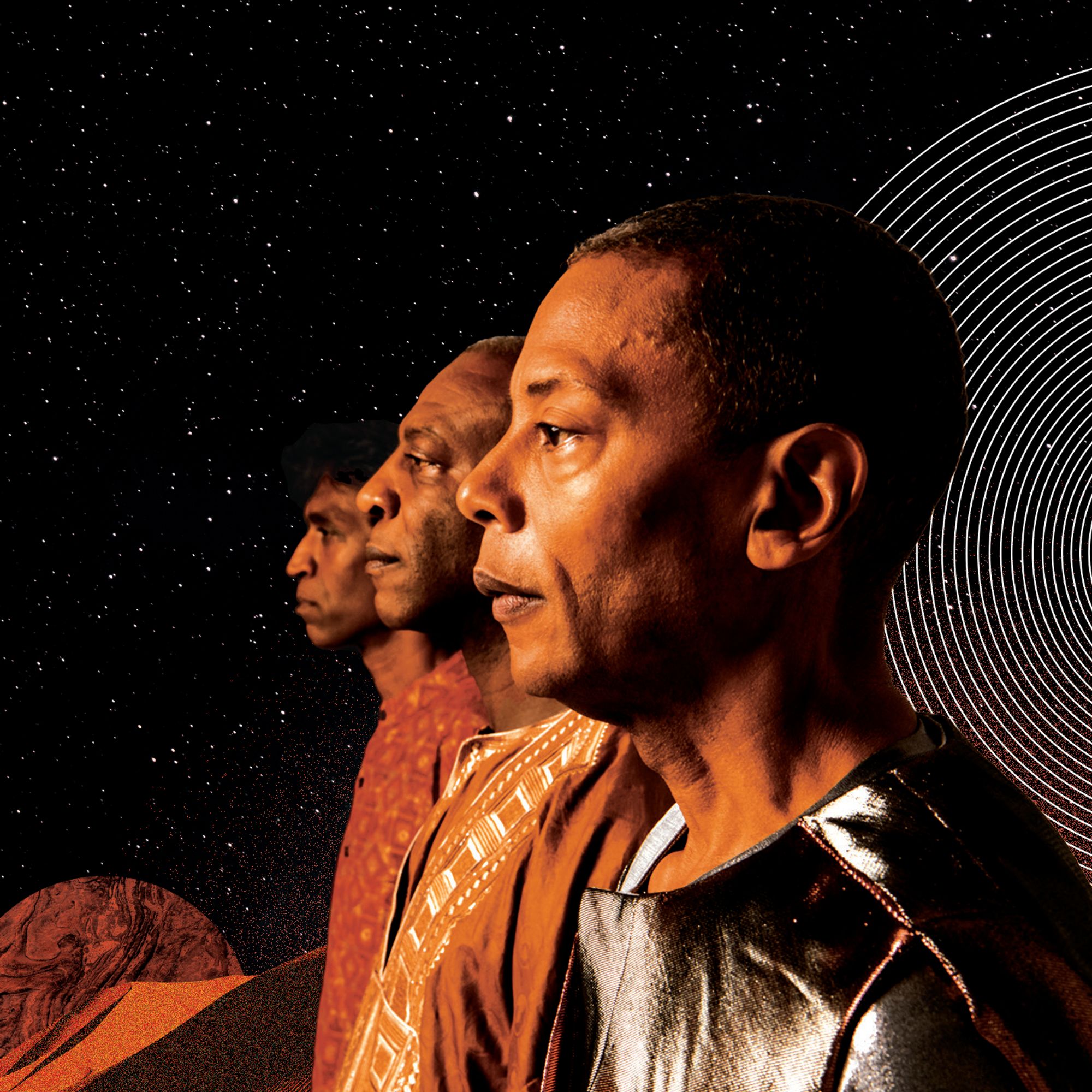
Jeff Mills, Jean-Phi Dary, and Prabhu Edouard.
Someone does something and then you answer it, and then someone else does something else. And before we know it, we're in the performance.
We're listening the same way as someone would sitting in the audience. I'm listening to Jean-Phi do something and it gives me an idea of where the tempo might be 'cause, you know, we're unsynced.
It's all about feel and intuition and having a conversation. He’ll say something with a note or a chord, and I’ll answer that with a beat. And Prabhu expands upon that and then it shifts. I've got these pieces of equipment; I see what they say, and then we figure it out from there.
If I had to fill out an application and it asked me what my job description was, I’d say my job is to play music that allows people to find more of themselves. In New York, the percentage of people who already know themselves, who are immediately ready to go, is much greater. But in a smaller town, you know, maybe people are more shy and reluctant.
Hopefully, you’ll never have to fill out another job application in your life. It takes a great deal of compassion and empathy to settle on the ideas that have become the focus of your practice. You could’ve said, "Oh, no. I'm going to be the 909 impresario," you know? But for you, it’s all about making connections with and for people.
For what I'm trying to materialize, it's better to be open and rarely conclude anything about how things should be. I always think that there's room for improvement, modification, enhancement. And if things are what they are and need to stay the same because change is not possible, then I tend to move on. That stagnancy is always a clear sign that I need to switch onto something else that is more questionable, undetermined, and unfinished.
That’s what I enjoy the most: looking at something that I can turn upside down, and then expanding on that new perspective. The 909 drum machine wasn’t meant to be used in a way where the stop and start played rhythms. But by turning the machine upside down and looking at it differently, it opened a whole new way of drumming, I suppose.
I mean, it's truly artistic, in the contemporary and conceptual sense, to see the instrument itself as a piece of art that can be re-contextualized, too.
Yeah. Most instruments are about striking things. You're striking and pressing the strings or buttons or keys. On the 909, it's the same.
If you know anything about electronics and the circuitry of these machines, there's a certain amount of frame that you're dealing with in each sound. And you can give the impression that you’re modifying the width or dimensions of that frame with silence. You can create the effect of a drum roll or you can sound like you're accenting something that has no accent. That was what I learned from Tony Allen.
Every electronic music producer should try it. It shows you that electronic music has never been far from classical and jazz compositions. I think electronic music producers need to find more ways to put their characters into the finished product.
I couldn't agree more.
I'm left-handed, so what I do with a drum machine comes out a certain way. I've been doing these things for years now, waiting to hear other musicians approach it all from new angles. I’m still waiting. ♦
Subscribe to Broadcast