Father and Son
Eileen Myles and Ariana Reines at the launch of Wave of Blood, Pioneer Works, 2025.
Photo: Ester SegrettoI think the bad or absent father is the central motif of Western literature. It’s there in the Old Testament again and again, and of course it’s the story of the Odyssey. I’m trying to think of an urtext with a good patriarch. I think the only way it ever works out in Judeo-Christian culture is with Jesus, who I would argue becomes a woman through the Passion and Resurrection. He’s the Son, transmuted through his ordeal into the Mother, whose body and blood nourish the world.
My father and I are estranged. I’ve tried a lot of different things over the years to heal our relationship, and to settle my emotions about how much it has hurt me—to sort out my feelings about him, the overpowering, almost suffocating rage I sometimes feel, and the agony he has provoked. The years have become a lifetime of living death and erasure. It’s just decades of birthdays without even a phone call, and neither of us can handle the pain the other causes—my rejection has hurt him, I know. And his rejection of me—well, you’re looking at the evidence.
I think if we’d ever been able to reach one another, I might not have had to become a poet.
He caused me visceral disgust, he made me never want to touch a man, he made me enjoy hurting men and seeking to be hurt by them. The thought of his face has always embarrassed me, and the ways I resemble him unnerve me.
Because of him I had to become a father to myself—and he’s the reason so many of my dyke friends call me “Daddy.” I have an old-fashioned man inside me. He’s not my dad, he’s not some other guy—he’s someone firm and true you can rely on—who I myself depend on when the woman in me needs to be held, comforted, and soothed.
I guess my gender has never quite fit, or I haven’t sorted out how to have fun with it and make it legible yet—or maybe I don’t want to. I remember one summer in P-town, hoisting my suitcase into Eileen’s black Prius, wearing a long green dress. “You’re kind of butch,” said Eileen, with that deeply Boston combination of derision and reverence. “Thank you for seeing me,” I said.
My old friend Richard Hell, who has the same birthday as my dad, puts artists into two camps—there are the artists who had parents who loved them and then there are the rest of us.
My illegibility both scares and protects me. My fatherlessness has been the loneliness of my life. It’s my gender.
Things that people see in my work—defiance, maybe some cruelty, an incapacity to ever join any club that would have me as a member—all this comes, I think, from the trouble I have always had accepting that my father was and is . . . the man who had to be my father.
I’ve wrestled with who he is and how lonely it made me, when my mom was on the streets, and then when she took her own life.
The problem with my book, Wave of Blood, is it tries to do something impossible, and maybe deeply wrong, which is bear witness to an immense and ongoing crime against humanity, a catastrophe, a genocide in which almost all of us are complicit—while also trying to deal with the fact that all of us are watching, all of us are seeing, and that we bring our own personal problems and traumas to what we see.
The way one agony is hurled against another, and manipulated by politicians and corporations to keep us limbic and robotic, in a ricochet of tribalism, horror, fight-or-flight—it’s something I felt I needed to reckon with, to use my body to reckon with.
One question people have asked me about my book Wave of Blood—a question I resent—was why didn’t I wait. Why didn’t I wait until the genocide was over, until it was safer, to write what I wrote?
My whole poetics came out of not being able to wait. I couldn’t wait for my family emergencies to calm down in order to finally become an artist. I didn’t get to metabolize my mother’s suicide without an immense moral catastrophe implicating the whole world, my fellow Jews especially.
A poet’s job, I think, is to show up in the world in their wholeness, with their magic capacity to connect to the muse intact and alive. This is what Eileen’s work and example have taught me. Eileen has shown the world what it means to move through every kind of space and state in fidelity to the bardic gift. Their poetry summons you into a state of presence, lightning alertness, and trust in living. Their poetry is Eileen and Eileen incarnates the true life of a true poet that makes them and their vision able to cross every boundary, passing in and out of every world.
Their friendship has saved me as their art has taught me—and the proof is in the pudding, how quantum and durable queer kinship is. Father Son Mother Brother Holy Ghost. Sister too. And Dog. We are all kin. This goes out to everyone, especially the ones who hurt on Father’s Day. Free Palestine.
—Ariana Reines
The following conversation, which we’re pleased to release in honor of Father’s Day, occurred at Pioneer Works on February 11, 2025, in celebration of the release Ariana Reines’ Wave of Blood, and of the filial ties that join two poets we cherish.
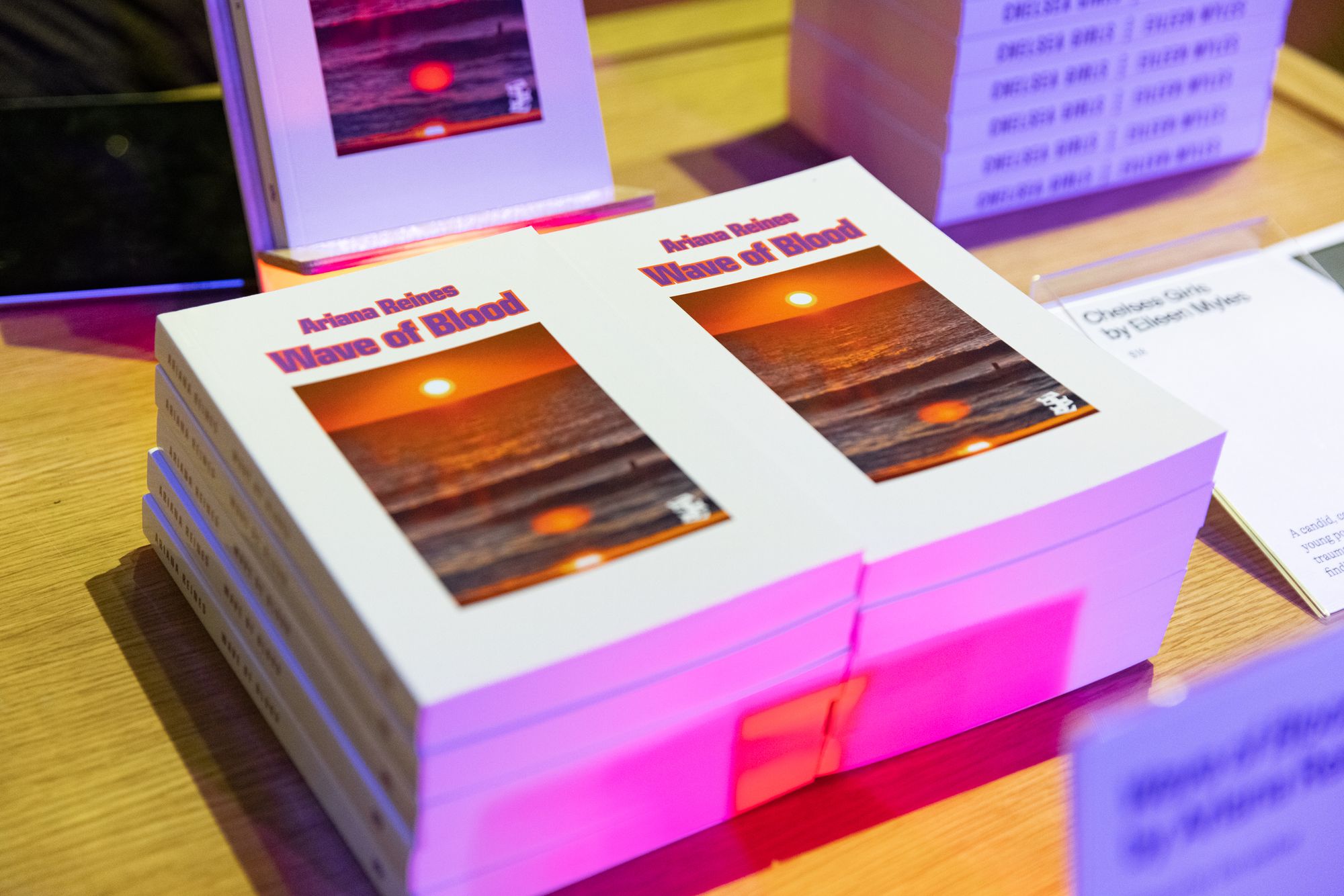
Wave of Blood by Ariana Reines at Pioneer Works, 2025.
Photo: Ester SegrettoWe should probably explain Fathers and Sons first. My father died on October 24, 1961. He was quite young when he died, and I was quite young. For years, I couldn't remember his death date. No matter how many times I learned it, it would just escape me. Then, at some point in the last five or 10 years, I suddenly knew that it was October 24. It was kinda great. I felt like I was becoming untraumatized in some way, to the extent that I could remember that simple thing. We have known each other for probably 20 years, and at some point in our friendship, it was revealed that this was your birthday. And so it just became that I call Ariana “Dad.”
In my family, I always felt like I was a son, and somehow I got screwed out of that by having a brother and a sister. And there is much in this book, I think, that supports the thesis of you being a father.
I just wanna add that the way that you gave me this information was to console me. Eileen is able to say things to me when I'm inconsolable that do console me.
You told me that at a moment when I was just devastated, and somehow I was just able to recenter myself on the planet with that knowledge. I feel like Western literature is full of terrible fathers and their sons trying to deal with that. The canon, as I received it, was always about the father and the son, and I felt like I had to build my own father inside me in order to survive in this world. When you gave me that, it, like, changed my body. So thank you.
You're welcome. My pleasure.
Something that people don't know is that I managed to get myself voted hottest guy in high school.
So good.
I wasn't gonna get the hottest girl.
Yeah. At least twice [in the book] you say that you felt like your mother's husband.
I did. It exists in all my books that I had a very distressed mother. But when I was first in Haiti, I was in a car accident, and I found myself standing in front of the wisest man I've ever met. The first thing he said to me was, "What's going on with your mother?" He had asked for my birthday. He had cast my birth chart and done it in a ballpoint pen. And he said, "You're suffering because you're trying to be your mother's father." And I was like, "What?" That thought had never entered my mind.
Well, it's sort of interesting that psychic care is gendered in a way.
It is, though.
When my mother died, and the war [on Gaza] started, I was so angry at the world and at myself, and I was so disoriented that all I wanted to do was crawl back into her body, and then from there, I wanted to crawl back into my grandmother's body. And the only thing that I could think about desiring was to be in their wombs. I used to hate the Freudian idea from twentieth-century literature that male writers wanted to get back into their mothers’ wombs, but then it happened to me. I just wanted to crawl back through the cosmic yoni into heaven, and I didn’t want to be in this world.
This book is the story of your mother and the effect of her in your life, and even the awareness of that within our shared queer community of writers and poets. When she needed help, you went on social media and shared [about it]. And when she finally died, it seemed to create a new order in your life and even in this collective life, you know?
Well, wildly, I was here in New York when she died, launching Pathetic Literature with you. And the night that she died, I was here at Pioneer Works, having a wonderful conversation about the origins of mathematics and writing. [Her death] did reorganize my life.
The book itself is not a memoir. Would you like to say something about that or not?
Well, that was a real challenge. I mean, the formal constraints of this book were the eclipses of October 2023 to April 2024. But the only way I could write it was to not write a memoir about my mother's suicide.
That was a rule you set up for yourself.
I did. I don't think of the book as being about me, even though it's very intimate.
You don’t tout story, and that delighted me so much. In so many circles, telling stories and making stories [is thought to be] what being human is about, and it becomes a feel-good structure to waste a little time and create pseudo-community and then destroy things anyway.
The backdrop [I wrote against] was the moral, spiritual, and actual catastrophe of [2023 and 2024]. Part of what we’re supposed to do when we tell a story is to humanize ourselves so that people will feel sympathy and empathy for us, and then they won’t kill us. This is the idea, and it’s a disgusting idea.
There's an epigraph in the book, where Etel Adnan says, "Science must not replace pain because when that kind of a catastrophe happens, it has no mercy." It’s an extremely precise and fascinating statement. I was trying to take that hot ore of pain but not turn it into story. The last thing I want to do is make people sympathize with me.
As a writer, it was so interesting for me [to read your repetitions.] You'd start a new section with something like, "My mother died, da, da, da," [often adding the same details over and over again]. When my father died, it was a traumatic event. I can't tell you how many times I've written it, and I keep writing it again and again. I think repetition is a way of saying, finally, that this is true, this is true. That kind of musicality moves into your body and makes a whole different instrument than the act of telling a story or making a memoir. You link it to something as beautiful as the flow of blood. So the mother dies again, and there's blood, and the mother dies again, and there's blood.
As I read your book, I felt enmeshed in the rhythm of the saga. Sagas are not new stories. They’re old stories being told again and again, and finally they become a shared experience.
It's the rhythm of the saga that gives life, and rhythm's what poetry's made of. I think rhythm saves our lives. In that Joan Didion quote that everyone [loves], "We tell ourselves stories in order to live," she's [actually] being very ironic, acerbic. She's not saying that in a heroic way. It’s absolutely true, but there's also something hazardous and weak about it. When she says we tell ourselves stories, she also means we lie to ourselves. Of course, that’s been totally co-opted and misunderstood because [her words are] taken out of context. It doesn't mean that it's not also magnificent that we tell ourselves stories, and it doesn't mean that our lives don't depend on it. But also—we lie to ourselves in order to live. We live on the lies we keep telling.
In editing it [the book], I was actually able to do some surgery on my own story, which had become almost ideological.
What do you mean by that?
Just emotional assumptions I was making about myself because I was so used to the fact that I was preparing my whole life for my mother to die. I never had a career or an adulthood or an experience of youth without her being in a damaged, frightening, menacing condition. Anything that was ever good or hopeful in my life would always get bulldozed and destroyed by her. I used to say when she was alive that it was a little bit like I had been a teen mom. It was extremely difficult, and horribly confusing, and quite silly to try to become a poet in the midst of my mother deepening into schizophrenia and becoming more and more unhousable. But I've had a very nice relationship with her since she died. For the first time in my life, I feel her love and support.
I was just remembering, Eileen, when we went to that beautiful wedding, and I found you in a corner and was just like, “These people’s families really love them.”
Oh, right. Yeah, that’s painful.
I just didn’t know that there were people—our friends—artists—who were so loved like that. I was so overwhelmed that I confided in you. And you, again, comforted me and set me back on Earth. We were together in secret comradeship, outcast from that family love, maybe the kind of love that produces marriages . . . I was not yet your father, but soon to be.
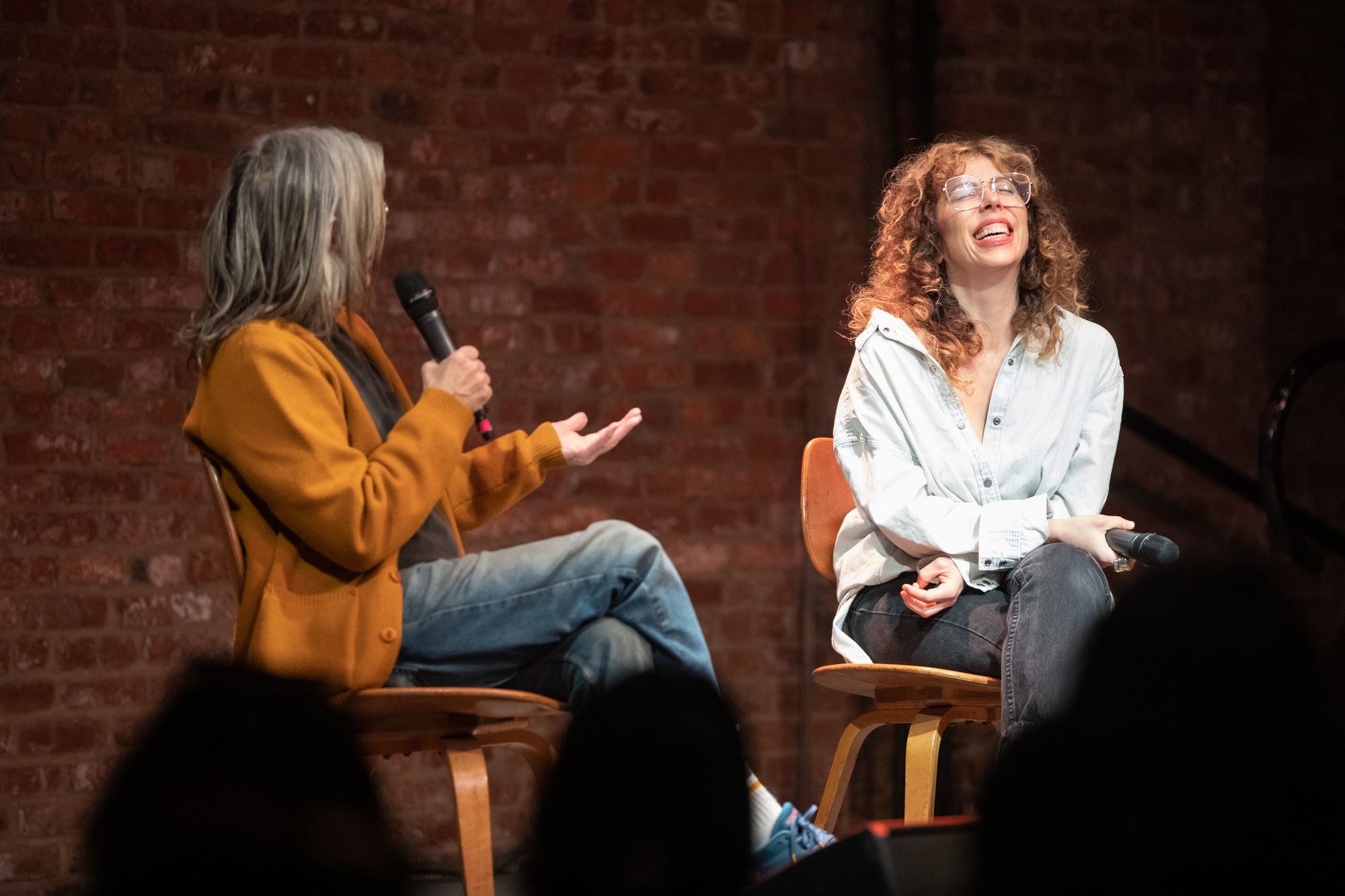
Eileen Myles and Ariana Reines at Pioneer Works, 2025.
Photo: Esther SegrettoThe narrative of the book seems to be that the mother dies, which is about to change everything, and then there's a war. You're mourning in a way that's so political. You’re thinking about Israel and asking: How do you make a state? How do you make a state out of loss, or out of the absence of grief?
I felt this incredibly private sadness on behalf of my mother and my grandmother during this time because my grandmother's entire family was exterminated, and because my mother grew up with no family, and because her condition, her mental illness, her total impossibility as a person, was directly a result of everything that had happened to her mother.
I have a dear friend who's a translator and a poet, Bill Martin, who lives in Berlin. When my mom died, he immediately went and got all these documents about my family. He found everything that he could find, including the disembarkation document from the boat that my family took to come to this country after the war, in 1950. My grandmother was pregnant with my mother. They took a boat called the SS Liberté, and they arrived in this country on October 24.
So because of Bill, I learned it was my destiny to be an American because my family came to this country on my birthday—and your father’s death day. But they could have easily emigrated to Israel. I could have easily been Israeli. I was also wrestling with a huge amount of internalized antisemitism, I guess.
You mean in the sense of being mad at Jews or Israelis?
I'm already very separated from what it might have felt like to be Jewish for my grandmother's parents or something. My experience of being Jewish was mostly through pain and death. Just the kind of sadness that breaks your brain.
One of the things I thought while reading this book is that you almost take a menstrual approach to political protest.
I'm going to take that as a compliment. Writing and bleeding have always been the same to me. Menstruation is very connected to my writing, and I think that if I were a man, I’d unfortunately probably be very involved with my dick. My friends used to call me Mensa because I’m so menstrual. It’s always been in my work, and we have a lot of jokes about it, you and I. I’m always like, “This is my activism.” The same goes for no bra.
There’s still a taboo around menstrual flow. It's very powerful and unpleasant in many ways. It's an overwhelming experience of a wave that comes through you that is not your choice, that you have to organize yourself around. In that sense, there’s a lot of virility in it, I think.
I know that going out and protesting at that time felt wrong for you. You said, "I'm not done grieving." And it felt like you were talking about your mother, but I thought you were also talking about Israel.
Of course I was, yeah. I know and love a lot of people who do protest and get a lot of comfort and joy from it.
I go to cry.
Exactly.
[For me, protesting can be] like going to the gym. I would go to the protest in Washington Square Park at 4:00, and I would start chanting, and then I would start crying. It was like going to have an orgasm, and then I would leave. I needed to be with a group of people saying words together, because otherwise I felt so crazy.
But I loved and respected your decision. We get to say what political means, and it takes so many shapes and forms, the same way a book does.
I think that I felt like I was holding vigil. I was just in a raw state where I felt like I couldn't trust other people to hold me. I stopped eating while I was writing this book, and I sort of made myself sick; I think I was starting to trust only my mother’s body and my grandmother’s body that I was trying to climb through in my consciousness. I didn’t want anything from this world inside me. I got kind of exhilarated that I was eating myself, and then I got really sick, and while I had a fever, I heard this feminine voice in my head who said, "That's too much suffering. Stop it."
That really changed me, and I saw that I was actually recapitulating something my mom had done for her mom, which was to try and suffer for her so she wouldn’t be alone. I was doing it to myself because I was so angry about the genocide, and I thought, "I can do this to myself. I have that power."
I remember saying to my boyfriend, when I was working on the book: “Nobody can make me do this, and nobody can stop me. Nobody can make me write Wave of Blood, and nobody can stop me.” I found that very exhilarating.
The thing that is so great about writing is that nobody can stop you. That's not true if you're an actor; you've gotta get a gig, you know? If you're a filmmaker, you have to get some money. But if you're a writer, you can just fucking do it. Career and business and all that come later, but the absolute act is so existential.
I was thinking about Marguerite Duras's notebook that she had kept while her husband, Robert Antelme, was at Auschwitz. And she found the notebook years later and said that she had no memory of having kept it. That was a text that had meant so much to me when I was writing my first book in my 20s because she was in a state of almost insanity. She had managed to write at a time when it was impossible to.
I was in an impossible state as a young woman, and I couldn't wait to become a poet. I couldn't wait for my family to settle down. I couldn't wait. I had to do it right then, you know? And Duras' book showed me that it was possible. I thought, "I don't know what I'm supposed to do with my life, but I'm in agony, so I can make a document." But it wasn't simple.
My favorite books to read are the diaries of people. The whole purpose of reading diaries and letters is to find out if people had any money and who they were sleeping with, which is what you don't get from the masterpieces. Unless the artist purposefully puts that into their masterpieces, which you do, and which I do. But we do it as a matter of politics, and also out of a sense of joy.
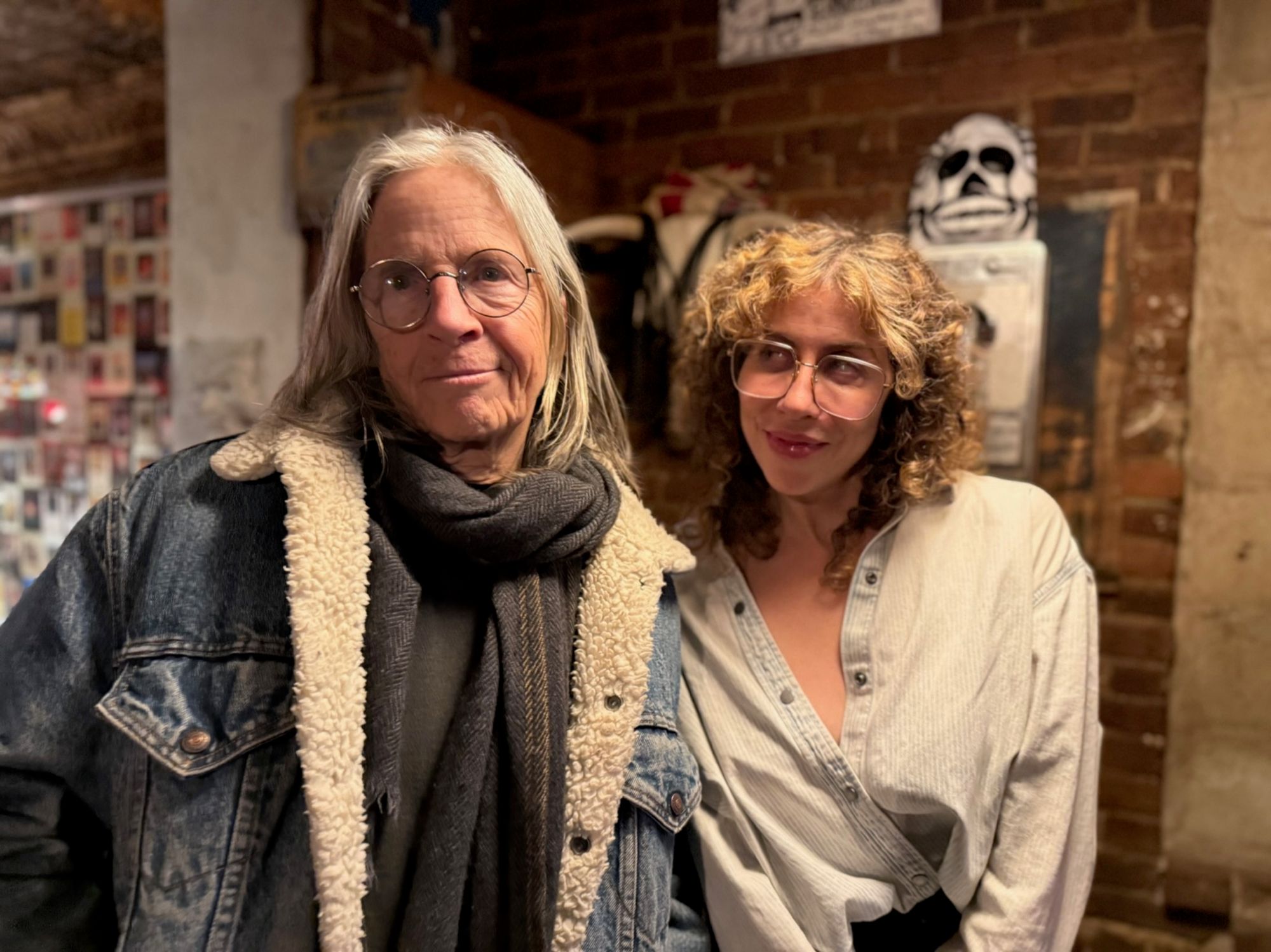
Eileen Myles and Ariana Reines.
Photo: Richard Joon YooAnd also a sense of history.
You can learn so much by finding out how artists were feeling when things were really terrible. I find those documents to be incredibly important.
Well, you mentioned Kafka's diaries and how he was so uncomfortable with his body.
Yes, I love that. Kafka hated his body. [laughs] When I first read those diaries, I think I was 23, and I was so exhilarated by how uncomfortable he was.
This upsets our gender idea, of course. Why is this man writing about being uncomfortable with his body? Not that I don't think men are uncomfortable with their bodies.
Of course they are. But that's not what great literature is made of. If you think about it, Tolstoy was miserable in his body, and he couldn't stand his dick, and he did everything he could to try to master it. Flaubert was miserable in his body, which is why he became a woman in Madame Bovary. Baudelaire was a wreck.
That's not the way I was taught literature, but once you get into it, embodiment is so wretched. The discomfort is fascinating, and I think it's quite boring to experience gender discomfort in oneself as a female. To me, this is a product of magazines. It's a very recent and dreary notion that only women are physically uncomfortable.
One of the things I love in your book, too, is how you talk about how everyone is freaked out that AI is eating their books. Everybody was upset in the poetry world.
A couple of weeks before that, a bunch of people's books literally got plagiarized and put into the large language models. And a couple of mine were taken. I'm sure yours were too.
Absolutely. Technology is just radically entering our lives. We've never had such intimacy with war, you know? With that information, with that burden, how can anyone be sane? Go to the gym, write a poem, and . . . I mean, there's something so obscene about it.
And then comes AI, also enabling the killing.
I do think technology is all over this book. And the book itself is a technology. You talk about cut-ups in the '60s where people started to triple fold a text because they started to think language was manipulating them. We don't do cut-ups as much now because we're living in a cut-up.
I feel like the cut-up brought us a lot of spiritual new territory in art. I'm very fond of the book The Third Mind that Burroughs wrote with Brion Gysin. It's very vaginal.
And it's also kinda mystical. They're doing chance operations with existing text to try to get at something deeper and more true and real. You could do that when you had print. Now, language is flowing through our screens. It's very hard to cut that up. Thought and ideology is moving more quickly, and you have to find a kind of third mind. Or you still have to find a way into the present that allows your spirit some space to discover something new. Because it can't just be that we all become soulless killer robots and die. It can't just be that the IRS audits my anal cavity and I die. I just can’t believe that. ♦
Subscribe to Broadcast